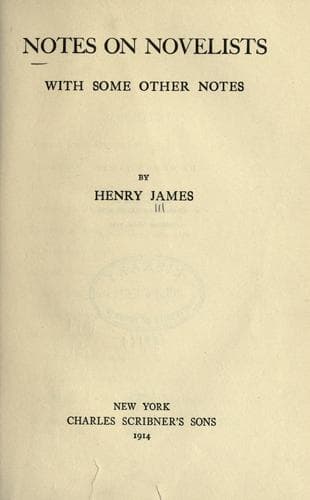
Notes on Novelists, with Some Other NotesJames, Henry
History
Notes on Novelists, with Some Other Notes
James, Henry
Fiction -- History and criticism; Novelists
are, it strikes me, of a new growth, and spring from a perverse desire
on the part of the erotic novelist to secure for the adventures he
depicts a dignity that is not of the essence. To compass this dignity he
has to cultivate the high pitch and beat the big drum, but when he has
done so he has given everything the wrong accent and the whole the wrong
extravagance. Why see it all, we ask him, as an extravagance of the
solemn and the strained? Why make _such_ an erotic a matter of tears and
imprecations, and by so doing render so poor a service both to pleasure
and to pain? Since by your own free showing it is pre-eminently a matter
of folly, let us at least have folly with her bells, or when these
must—since they must—sound knells and dirges, leave them only to the
light hand of the lyric poet, who turns them at the worst to music.
Matilde Serao is in this connection constantly lugubrious; even from the
little so-called pastels of “Gli Amanti” she manages, with an ingenuity
worthy of a better cause, to expunge the note of gaiety.
This dismal _parti pris_ indeed will inevitably, it is to be feared,
when all the emancipations shall have said their last word, be that of
the ladies. Yet perhaps too, whatever such a probability, the tone
scarce signifies—in the presence, I mean, of the fundamental mistake
from which the author before us warns us off. That mistake, we gather
from her warning, would be to encourage, after all, any considerable
lowering of the level of our precious fund of reserve. When we come to
analyse we arrive at a final impression of what we pay, as lovers of the
novel, for such a chartered state as we have here a glimpse of; and we
find it to be an exposure, on the intervention at least of such a
literary temperament as the one before us, to a new kind of vulgarity.
We have surely as it is kinds enough. The absence of the convention
throws the writer back on tact, taste, delicacy, discretion, subjecting
these principles to a strain from which the happy office of its presence
is, in a considerable degree and for performers of the mere usual
endowment, to relieve him. When we have not a very fine sense the
convention appears in a manner to have it on our behalf. And how
frequent to-day, in the hurrying herd of brothers and sisters of the
pen, _is_ a fine sense—of _any_ side of their affair? Do we not
approach the truth in divining that only an eminent individual here and
there may be trusted for it? Here—for the case is our very lesson—is
this robust and wonderful Serao who is yet not to be trusted at all.
Does not the dim religious light with which we surround its shrine do
more, on the whole, for the poetry of _passione_ than the flood of
flaring gas with which, in her pages, and at her touch, it is drenched?
Does it not shrink, as a subject under treatment, from such expert
recognitions and easy discussions, from its so pitiless reduction to the
category of the familiar? It issues from the ordeal with the aspect with
Public-domain text, read in full here on John Shaqi.
Reviews
Reviews
No reviews yet
Be the first to share your thoughts on this work.
Elsewhere in the archive
Join the Discussion
Join the discussion
Sign in to leave a comment or review.
Sign InorCreate an account