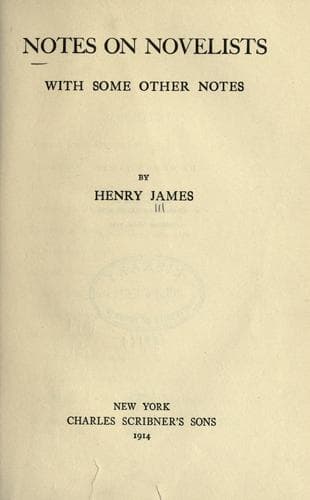
Notes on Novelists, with Some Other NotesJames, Henry
History
Notes on Novelists, with Some Other Notes
James, Henry
Fiction -- History and criticism; Novelists
Our argument is that each is ideally immersed in his own body of
reference, and that immersion in any such degree and to the effect of
any such variety, intensity and plausibility is really among us a new
feature of the novelist’s range of resource. We have seen him, we have
even seen _her_, otherwise auspiciously endowed, seen him observant,
impassioned, inspired, and in virtue of these things often very
charming, very interesting, very triumphant, visibly qualified for the
highest distinction before the fact and visibly crowned by the same
after it—we have seen him with a great imagination and a great sense of
life, we have seen him even with a great sense of expression and a
considerable sense of art: so that we have only to reascend the stream
of our comparatively recent literature to meet him serene and immortal,
brow-bound with the bay and erect on his particular pedestal. We have
only to do that, but have only also, while we do it, to recognise that
meantime other things still than these various apotheoses have taken
place, and that, to the increase of our recreation, and even if our
limited space condemns us to put the matter a trifle clumsily, a change
has come over our general receptive sensibility not less than over our
productive tradition. In these connections, we admit, overstatement is
easy and over-emphasis tempting; we confess furthermore to a frank
desire to enrich the case, the historic, with all the meaning we can
stuff into it. So viewed accordingly it gives us the “new,” to repeat
our expression, as an appetite for a closer notation, a sharper
specification of the signs of life, of consciousness, of the human scene
and the human subject in general, than the three or four generations
before us had been at all moved to insist on. They had insisted indeed,
these generations, we see as we look back to them, on almost nothing
whatever; what was to come to them had come, in enormous affluence and
freshness at its best, and to our continued appreciation as well as to
the honour of their sweet susceptibility, because again and again the
great miracle of genius took place, while they gaped, in their social
and sentimental sky. For ourselves that miracle has not been markedly
renewed, but it has none the less happened that by hook and by crook the
case for appreciation remains interesting. The great thing that saves
it, under the drawback we have named, is, no doubt, that we have
simply—always for appreciation—learned a little to insist, and that we
thus get back on one hand something of what we have lost on the other.
We are unable of course, with whatever habit of presumption engendered,
to insist upon genius; so that who shall describe the measure of success
we still achieve as not virtually the search for freshness, and above
all for closeness, in quite a different direction? To this nearer view
of commoner things Mr. Wells, say, and Mr. Arnold Bennett, and in their
degree, under the infection communicated, Mr. D. H.
Public-domain text, read in full here on John Shaqi.
Reviews
Reviews
No reviews yet
Be the first to share your thoughts on this work.
Elsewhere in the archive
Join the Discussion
Join the discussion
Sign in to leave a comment or review.
Sign InorCreate an account