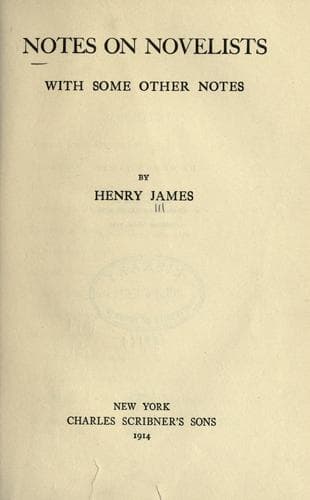
Notes on Novelists, with Some Other NotesJames, Henry
History
Notes on Novelists, with Some Other Notes
James, Henry
Fiction -- History and criticism; Novelists
The author of
“Tono-Bungay” and of “The New Machiavelli,” and the author of “The Old
Wives’ Tale” and of “Clayhanger,” have practically launched the boat in
which we admire the fresh play of oar of the author of “The Duchess of
Wrexe,” and the documented aspect exhibited successively by “Round the
Corner,” by “Carnival” and “Sinister Street,” and even by “Sons and
Lovers” (however much we may find Mr. Lawrence, we confess, hang in the
dusty rear). We shall explain in a moment what we mean by this
designation of the element that these best of the younger men strike us
as more particularly sharing, our point being provisionally that Mr.
Wells and Mr. Arnold Bennett (speaking now only of them) began some time
back to show us, and to show sundry emulous and generous young spirits
then in the act of more or less waking up, what the state in question
might amount to. We confound the author of “Tono-Bungay” and the author
of “Clayhanger” in this imputation for the simple reason that with the
sharpest differences of character and range they yet come together under
our so convenient measure of value by _saturation_. This is the greatest
value, to our sense, in either of them, their other values, even when at
the highest, not being quite in proportion to it; and as to be saturated
is to be documented, to be able even on occasion to prove quite enviably
and potently so, they are alike in the authority that creates emulation.
It little signifies that Mr. Wells’s documented or saturated state in
respect to a particular matter in hand is but one of the faces of his
_generally_ informed condition, of his extraordinary mass of gathered
and assimilated knowledge, a miscellaneous collection more remarkable
surely than any teller of “mere” tales, with the possible exception of
Balzac, has been able to draw upon, whereas Mr. Arnold Bennett’s
corresponding provision affects us as, though singularly copious,
special, exclusive and artfully economic. This distinction avails
nothing against that happy fact of the handiest possession by Mr. Wells
of immeasurably more concrete material, amenable for straight and vivid
reference, convertible into apt illustration, than we should know where
to look for other examples of. The author of “The New Machiavelli”
knows, somehow, to our mystified and dazzled apprehension, because he
writes and because that act constitutes for him the need, on occasion a
most desperate, of absorbing knowledge at the pores; the chronicler of
the Five Towns writing so much more discernibly, on the other hand,
because he knows, and conscious of no need more desperate than that
particular circle of civilisation may satisfy.
Public-domain text, read in full here on John Shaqi.
Reviews
Reviews
No reviews yet
Be the first to share your thoughts on this work.
Elsewhere in the archive
Join the Discussion
Join the discussion
Sign in to leave a comment or review.
Sign InorCreate an account