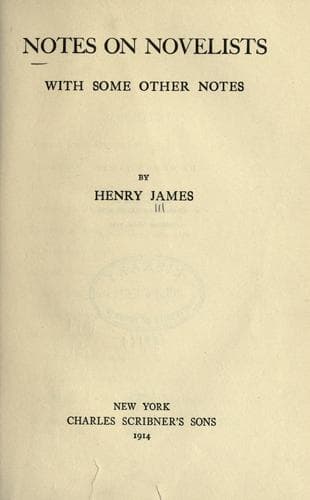
Notes on Novelists, with Some Other NotesJames, Henry
History
Notes on Novelists, with Some Other Notes
James, Henry
Fiction -- History and criticism; Novelists
So, to express it briefly, the possibility of hugging the shore of the
real as it had not, among us, been hugged, and of pushing inland, as far
as a keel might float, wherever the least opening seemed to smile,
dawned upon a few votaries and gathered further confidence with
exercise. Who could say, of course, that Jane Austen had not been close,
just as who could ask if Anthony Trollope had not been copious?—just as
who could _not_ say that it all depended on what was meant by these
terms? The demonstration of what was meant, it presently appeared, could
come but little by little, quite as if each tentative adventurer had
rather anxiously to learn for himself what _might_ be meant—this
failing at least the leap into the arena of some great demonstrative,
some sudden athletic and epoch-making authority. Who could pretend that
Dickens was anything but romantic, and even more romantic in his humour,
if possible, than in pathos or in queer perfunctory practice of the
“plot”? Who could pretend that Jane Austen didn’t leave much more untold
than told about the aspects and manners even of the confined circle in
which her muse revolved? Why shouldn’t it be argued against her that
where her testimony complacently ends the pressure of appetite within us
presumes exactly to begin? Who could pretend that the reality of
Trollope didn’t owe much of its abundance to the diluted, the quite
extravagantly watered strain, no less than to the heavy hand, in which
it continued to be ladled out? Who of the younger persuasion would not
have been ready to cite, as one of the liveliest opportunities for the
critic eager to see representation searching, such a claim for the close
as Thackeray’s sighing and protesting “look-in” at the acquaintance
between Arthur Pendennis and Fanny Bolton, the daughter of the Temple
laundress, amid the purlieus of that settlement? The sentimental habit
and the spirit of romance, it was unmistakably chargeable, stood out to
sea as far as possible the moment the shore appeared to offer the least
difficulty to hugging, and the Victorian age bristled with perfect
occasions for our catching them in the act of this showy retreat. All
revolutions have been prepared in spite of their often striking us as
sudden, and so it was doubtless that when scarce longer ago than the
other day Mr. Arnold Bennett had the fortune to lay his hand on a
general scene and a cluster of agents deficient to a peculiar degree in
properties that might interfere with a desirable density of
illustration—deficient, that is, in such connections as might carry the
imagination off to some sport on its own account—we recognised at once
a set of conditions auspicious to the newer kind of appeal. Let us
confess that we were at the same time doubtless to master no better way
of describing these conditions than by the remark that they were, for
some reason beautifully inherent in them, susceptible at once of being
entirely known and of seeming detectably thick.
Public-domain text, read in full here on John Shaqi.
Reviews
Reviews
No reviews yet
Be the first to share your thoughts on this work.
Elsewhere in the archive
Join the Discussion
Join the discussion
Sign in to leave a comment or review.
Sign InorCreate an account