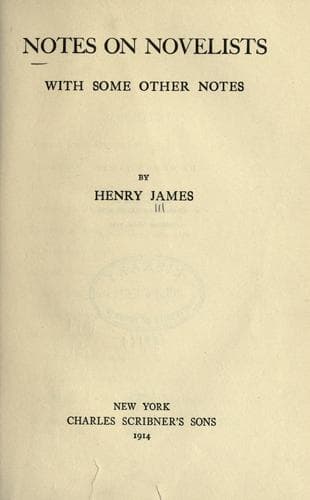
Notes on Novelists, with Some Other NotesJames, Henry
History
Notes on Novelists, with Some Other Notes
James, Henry
Fiction -- History and criticism; Novelists
Reduction to exploitable
knowledge is apt to mean for many a case of the human complexity
reduction to comparative thinness; and nothing was thereby at the first
blush to interest us more than the fact that the air and the very smell
of packed actuality in the subject-matter of such things as the author’s
two longest works was clearly but another name for his personal
competence in that matter, the fulness and firmness of his embrace of
it. This was a fresh and beguiling impression—that the state of
inordinate possession on the chronicler’s part, the mere state as such
and as an energy directly displayed, _was_ the interest, neither more
nor less, _was_ the sense and the meaning and the picture and the drama,
all so sufficiently constituting them that it scarce mattered what they
were in themselves. Of what they were in themselves their being in Mr.
Bennett, as Mr. Bennett to such a tune harboured them, represented their
one conceivable account—not to mention, as reinforcing this, our own
great comfort and relief when certain high questions and wonderments
about them, or about our mystified relation to them, began one after
another to come up.
Because such questions did come, we must at once declare, and we are
still in presence of them, for all the world as if that case of the
perfect harmony, the harmony between subject and author, were just
marked with a flaw and didn’t meet the whole assault of restless
criticism. What we make out Mr. Bennett as doing is simply recording his
possession or, to put it more completely, his saturation; and to see him
as virtually shut up to that process is a note of all the more moment
that we see our selected cluster of his interesting juniors, and whether
by his direct action on their collective impulse or not, embroiled, as
we venture to call it, in the same predicament. The act of squeezing out
to the utmost the plump and more or less juicy orange of a particular
acquainted state and letting this affirmation of energy, however
directed or undirected, constitute for them the “treatment” of a
theme—_that_ is what we remark them as mainly engaged in, after
remarking the example so strikingly, so originally set, even if an undue
subjection to it be here and there repudiated. Nothing is further from
our thought than to undervalue saturation and possession, the fact of
the particular experience, the state and degree of acquaintance
incurred, however such a consciousness may have been determined; for
these things represent on the part of the novelist, as on the part of
any painter of things seen, felt or imagined, just one half of his
authority—the other half being represented of course by the application
he is inspired to make of them. Therefore that fine secured half is so
much gained at the start, and the fact of its brightly being there may
really by itself project upon the course so much colour and form as to
make us on occasion, under the genial force, almost not miss the answer
Public-domain text, read in full here on John Shaqi.
Reviews
Reviews
No reviews yet
Be the first to share your thoughts on this work.
Elsewhere in the archive
Join the Discussion
Join the discussion
Sign in to leave a comment or review.
Sign InorCreate an account