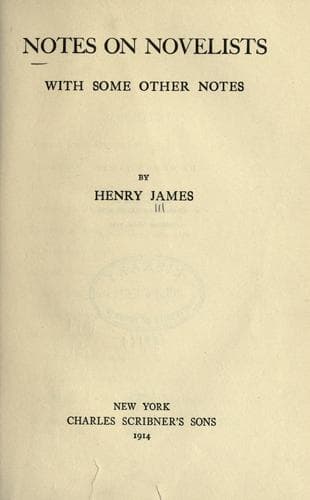
Notes on Novelists, with Some Other NotesJames, Henry
History
Notes on Novelists, with Some Other Notes
James, Henry
Fiction -- History and criticism; Novelists
pointed intention do comparatively gleam out of the two fictions last
named. “The Old Wives’ Tale” is the history of two sisters, daughters of
a prosperous draper in a Staffordshire town, who, separating early in
life, through the flight of one of them to Paris with an ill-chosen
husband and the confirmed and prolonged local pitch of the career of the
other, are reunited late in life by the return of the fugitive after
much Parisian experience and by her pacified acceptance of the
conditions of her birthplace. The divided current flows together again,
and the chronicle closes with the simple drying up determined by the
death of the sisters. That is all; the canvas is covered, ever so
closely and vividly covered, by the exhibition of innumerable small
facts and aspects, at which we assist with the most comfortable sense of
their substantial truth. The sisters, and more particularly the less
adventurous, are at home in their author’s mind, they sit and move at
their ease in the square chamber of his attention, to a degree beyond
which the production of that ideal harmony between creature and creator
could scarcely go, and all by an art of demonstration so familiar and so
“quiet” that the truth and the poetry, to use Goethe’s distinction, melt
utterly together and we see no difference between the subject of the
show and the showman’s feeling, let alone the showman’s manner, about
it. This felt identity of the elements—because we at least consciously
feel—becomes in the novel we refer to, and not less in “Clayhanger,”
which our words equally describe, a source for us of abject confidence,
confidence truly _so_ abject in the solidity of every appearance that it
may be said to represent our whole relation to the work and completely
to exhaust our reaction upon it. “Clayhanger,” of the two fictions even
the more densely loaded with all the evidence in what we should call the
case presented did we but learn meanwhile for what case, or for a case
of what, to take it, inscribes the annals, the private more
particularly, of a provincial printer in a considerable way of business,
beginning with his early boyhood and going on to the complications of
his maturity—these not exhausted with our present possession of the
record, inasmuch as by the author’s announcement there is more of the
catalogue to come. This most monumental of Mr. Arnold Bennett’s
recitals, taking it with its supplement of “Hilda Lessways,” already
before us, is so describable through its being a monument exactly not to
an idea, a pursued and captured meaning, or in short _to_ anything
whatever, but just simply _of_ the quarried and gathered material it
happens to contain, the stones and bricks and rubble and cement and
promiscuous constituents of every sort that have been heaped in it and
thanks to which it quite massively piles itself up. Our perusal and our
enjoyment are our watching of the growth of the pile and of the
capacity, industry, energy with which the operation is directed.
Public-domain text, read in full here on John Shaqi.
Reviews
Reviews
No reviews yet
Be the first to share your thoughts on this work.
Elsewhere in the archive
Join the Discussion
Join the discussion
Sign in to leave a comment or review.
Sign InorCreate an account