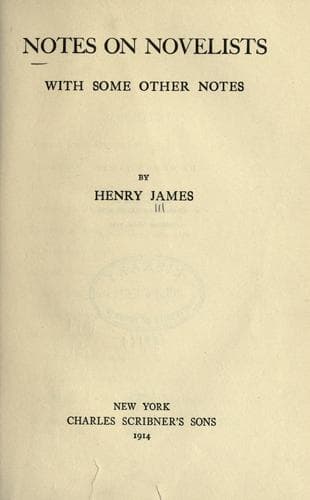
Notes on Novelists, with Some Other NotesJames, Henry
History
Notes on Novelists, with Some Other Notes
James, Henry
Fiction -- History and criticism; Novelists
great mark of the faith that for the novelist to show he “knows all
about” a certain congeries of aspects, the more numerous within their
mixed circle the better, is thereby to set in motion, with due
intensity, the pretension to interest. The state of knowing all about
whatever it may be has thus only to become consistently and abundantly
active to pass for his supreme function; and to its so becoming active
few difficulties appear to be descried—so great may on occasion be the
mere excitement of activity. To the fact that the exhilaration is, as we
have hinted, often infectious, to this and to the charming young good
faith and general acclamation under which each case appears to
proceed—each case we of course mean really repaying attention—the
critical reader owes his opportunity so considerably and so gratefully
to generalise.
II
We should have only to remount the current with a certain energy to come
straight up against Tolstoy as the great illustrative master-hand on all
this ground of the disconnection of method from matter—which encounter,
however, would take us much too far, so that we must for the present but
hang off from it with the remark that of all great painters of the
social picture it was given that epic genius most to serve admirably as
a rash adventurer and a “caution,” and execrably, pestilentially, as a
model. In this strange union of relations he stands alone: from no other
great projector of the human image and the human idea is so much truth
to be extracted under an equal leakage of its value. All the proportions
in him are so much the largest that the drop of attention to our nearer
cases might by its violence leave little of that principle alive; which
fact need not disguise from us, none the less, that as Mr. H. G. Wells
and Mr. Arnold Bennett, to return to them briefly again, derive, by
multiplied if diluted transmissions, from the great Russian (from whose
all but equal companion Turgenieff we recognise no derivatives at all),
so, observing the distances, we may profitably detect an unexhausted
influence in our minor, our still considerably less rounded vessels.
Highly attaching as indeed the game might be, of inquiring as to the
centre of the interest or the sense of the whole in “The Passionate
Friends,” or in “The Old Wives’ Tale,” after having sought those
luxuries in vain not only through the general length and breadth of “War
and Peace,” but within the quite respectable confines of any one of the
units of effect there clustered: this as preparing us to address a like
friendly challenge to Mr. Cannan’s “Round the Corner,” say, or to Mr.
Lawrence’s “Sons and Lovers”—should we wish to be very friendly to Mr.
Lawrence—or to Mr. Hugh Walpole’s “Duchess of Wrexe,” or even to Mr.
Compton Mackenzie’s “Sinister Street” and “Carnival,” discernibly, we
hasten to add, though certain betrayals of a controlling idea and a
Public-domain text, read in full here on John Shaqi.
Reviews
Reviews
No reviews yet
Be the first to share your thoughts on this work.
Elsewhere in the archive
Join the Discussion
Join the discussion
Sign in to leave a comment or review.
Sign InorCreate an account