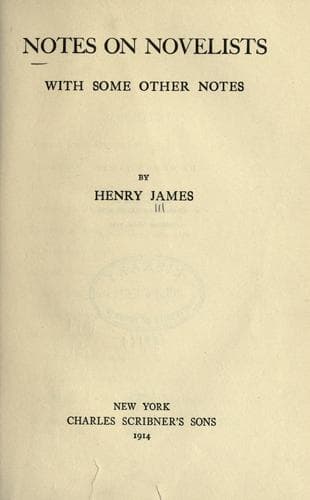
Notes on Novelists, with Some Other NotesJames, Henry
History
Notes on Novelists, with Some Other Notes
James, Henry
Fiction -- History and criticism; Novelists
If Mr. Bennett’s tight rotundity then is of the handsomest size and his
manipulation of it so firm, what are we to say of Mr. Wells’s, who, a
novelist very much as Lord Bacon was a philosopher, affects us as taking
all knowledge for his province and as inspiring in us to the very
highest degree the confidence enjoyed by himself—enjoyed, we feel, with
a breadth with which it has been given no one of his fellow-craftsmen to
enjoy anything. If confidence alone could lead utterly captive we should
all be huddled in a bunch at Mr. Wells’s heels—which is indeed where we
_are_ abjectly gathered so far as that force does operate. It is
literally Mr. Wells’s own mind, and the experience of his own mind,
incessant and extraordinarily various, extraordinarily reflective, even
with all sorts of conditions made, of whatever he may expose it to, that
forms the reservoir tapped by him, that constitutes his provision of
grounds of interest. It is, by our thinking, in his power to name to us,
as a preliminary, more of these grounds than all his contemporaries put
together, and even to exceed any competitor, without exception, in the
way of suggesting that, thick as he may seem to lay them, they remain
yet only contributive, are not in themselves full expression but are
designed strictly to subserve it, that this extraordinary writer’s spell
resides. When full expression, the expression of some particular truth,
seemed to lapse in this or that of his earlier novels (we speak not here
of his shorter things, for the most part delightfully wanton and
exempt,) it was but by a hand’s breadth, so that if we didn’t
inveterately quite know what he intended we yet always felt sufficiently
that _he_ knew. The particular intentions of such matters as “Kipps,” as
“Tono-Bungay,” as “Ann Veronica,” so swarmed about us, in their
blinding, bluffing vivacity, that the mere sum of them might have been
taken for a sense over and above which it was graceless to inquire. The
more this author learns and learns, or at any rate knows and knows,
however, the greater is this impression of his holding it good enough
for us, such as we are, that he shall but turn out his mind and its
contents upon us by any free familiar gesture and as from a high window
forever open—an entertainment as copious surely as any occasion should
demand, at least till we have more intelligibly expressed our title to a
better. Such things as “The New Machiavelli,” “Marriage,” “The
Passionate Friends,” are so very much more attestations of the presence
of material than attestations of an interest in the use of it that we
ask ourselves again and again why so fondly neglected a state of leakage
comes not to be fatal to _any_ provision of quantity, or even to stores
more specially selected for the ordeal than Mr. Wells’s always strike us
as being. Is not the pang of witnessed waste in fact great just in
proportion as we are touched by our author’s fine off-handedness as to
Public-domain text, read in full here on John Shaqi.
Reviews
Reviews
No reviews yet
Be the first to share your thoughts on this work.
Elsewhere in the archive
Join the Discussion
Join the discussion
Sign in to leave a comment or review.
Sign InorCreate an account