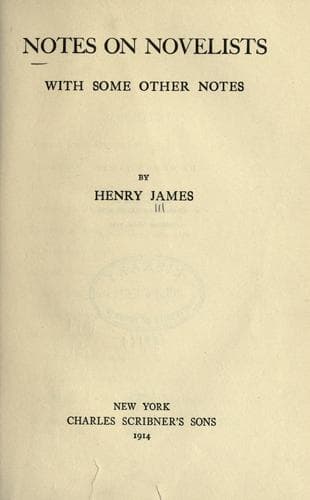
Notes on Novelists, with Some Other NotesJames, Henry
History
Notes on Novelists, with Some Other Notes
James, Henry
Fiction -- History and criticism; Novelists
but only that he strikes us as having received it, straight from nature,
with such a concussion as to have kept the boon at the stage of
violence—so that, fairly pinned down by it, he is still embarrassed for
passing it on. On the day he shall have worked free of this primitive
predicament, the crude fact of the convulsion itself, there need be no
doubt of his exhibiting matter into which method may learn how to bite.
The tract meanwhile affects us as more or less virgin snow, and we look
with interest and suspense for the imprint of a process.
If those remarks represent all the while, further, that the performances
we have glanced at, with others besides, lead our attention on, we hear
ourselves the more naturally asked what it is then that we expect or
want, confessing as we do that we have been in a manner interested, even
though, from case to case, in a varying degree, and that Thackeray,
Turgenieff, Balzac, Dickens, Anatole France, no matter who, can not do
more than interest. Let us therefore concede to the last point that
small mercies are better than none, that there are latent within the
critic numberless liabilities to being “squared” (the extent to which he
may on occasion betray his price!) and so great a preference for being
pleased over not being, that you may again and again see him assist with
avidity at the attempt of the slice of life to butter itself thick. Its
explanation that it _is_ a slice of life and pretends to be nothing else
figures for us, say, while we watch, the jam super-added to the butter.
For since the jam, on this system, descends upon our desert, in its form
of manna, from quite another heaven than the heaven of method, the mere
demonstration of its agreeable presence is alone sufficient to hint at
our more than one chance of being supernaturally fed. The happy-go-lucky
fashion of it is indeed not then, we grant, an objection so long as we
do take in refreshment: the meal may be of the last informality and yet
produce in the event no small sense of repletion. The slice of life
devoured, the butter and the jam duly appreciated, we are ready, no
doubt, on another day, to trust ourselves afresh to the desert. We break
camp, that is, and face toward a further stretch of it, all in the faith
that we shall be once more provided for. We take the risk, we enjoy more
or less the assistance—more or less, we put it, for the vision of a
possible arrest of the miracle or failure of our supply never wholly
leaves us. The phenomenon is too uncanny, the happy-go-lucky, as we know
it in general, never _has_ been trustable to the end; the absence of the
last true touch in the preparation of its viands becomes with each
renewal of the adventure a more sensible fact. By the last true touch we
mean of course the touch of the hand of selection; the principle of
selection having been involved at the worst or the least, one would
suppose, in any approach whatever to the loaf of life with the
_arrière-pensée_ of a slice.
Public-domain text, read in full here on John Shaqi.
Reviews
Reviews
No reviews yet
Be the first to share your thoughts on this work.
Elsewhere in the archive
Join the Discussion
Join the discussion
Sign in to leave a comment or review.
Sign InorCreate an account