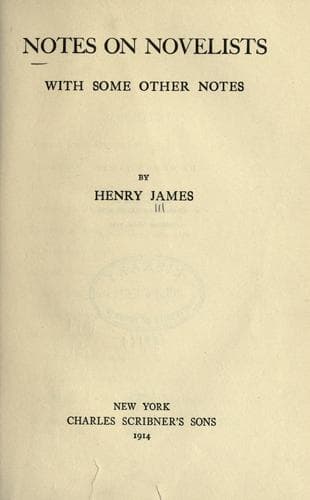
Notes on Novelists, with Some Other NotesJames, Henry
History
Notes on Novelists, with Some Other Notes
James, Henry
Fiction -- History and criticism; Novelists
Arnold Bennett’s esthetic
instinct than to anything like a calculation of his bearings, and more
to his thoroughly acquainted state, as we may again put it, than to all
other causes together: which strikingly enough shows how much complexity
of interest may be simulated by mere presentation of material, mere
squeezing of the orange, when the material happens to be “handsome” or
the orange to be sweet.
III
The orange of our persistent simile is in Mr. Hugh Walpole’s hands very
remarkably sweet—a quality we recognise in it even while reduced to
observing that the squeeze pure and simple, the fond, the lingering, the
reiterated squeeze, constitutes as yet his main perception of method. He
enjoys in a high degree the consciousness of saturation, and is on such
serene and happy terms with it as almost make of critical interference,
in so bright an air, an assault on personal felicity. Full of material
is thus the author of “The Duchess of Wrexe,” and of a material which we
should describe as the consciousness of youth were we not rather
disposed to call it a peculiar strain of the extreme unconsciousness.
Mr. Walpole offers us indeed a rare and interesting case—we see about
the field none other like it; the case of a positive identity between
the spirit, not to say the time of life or stage of experience, of the
aspiring artist and the field itself of his vision. “The Duchess of
Wrexe” reeks with youth and the love of youth and the confidence of
youth—youth taking on with a charming exuberance the fondest costume or
disguise, that of an adventurous and voracious felt interest, interest
in life, in London, in society, in character, in Portland Place, in the
Oxford Circus, in the afternoon tea-table, in the torrid weather, in
fifty other immediate things as to which its passion and its curiosity
are of the sincerest. The wonderful thing is that these latter forces
operate, in their way, without yet being disengaged and
hand-free—disengaged, that is, from their state of _being_ young, with
its billowy mufflings and other soft obstructions, the state of being
present, being involved and aware, close “up against” the whole mass of
possibilities, being in short intoxicated with the mixed liquors of
suggestion. In the fumes of this acute situation Mr. Walpole’s
subject-matter is bathed; the situation being all the while so much more
his own and that of a juvenility reacting, in the presence of
everything, “for all it is worth,” than the devised and imagined one,
however he may circle about some such cluster, that every cupful of his
excited flow tastes three times as much of his temperamental freshness
as it tastes of this, that or the other character or substance, above
all of this, that or the other group of antecedents and references,
supposed to be reflected in it. All of which does not mean, we hasten to
add, that the author of “The Duchess of Wrexe” has not the gift of life;
Public-domain text, read in full here on John Shaqi.
Reviews
Reviews
No reviews yet
Be the first to share your thoughts on this work.
Elsewhere in the archive
Join the Discussion
Join the discussion
Sign in to leave a comment or review.
Sign InorCreate an account