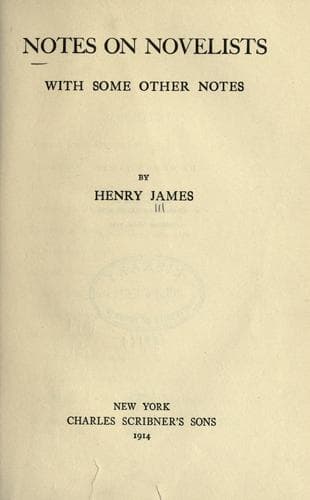
Notes on Novelists, with Some Other NotesJames, Henry
History
Notes on Novelists, with Some Other Notes
James, Henry
Fiction -- History and criticism; Novelists
Of an exquisite refinement at all events are the critical questions
opened up in the attempt, the question in particular of by what it
exactly is that the experiment is crowned. Pronouncing it crowned and
the case saved by sheer gallantry, as we did above, is perhaps to fall
just short of the conclusion we might reach were we to push further.
“Chance” _is_ an example of objectivity, most precious of aims, not only
menaced but definitely compromised; whereby we are in presence of
something really of the strangest, a general and diffused lapse of
authenticity which an inordinate number of common readers—since it
always takes this and these to account encouragingly for
“editions”—have not only condoned but have emphatically commended. They
can have done this but through the bribe of some authenticity other in
kind, no doubt, and seeming to them equally great if not greater, which
gives back by the left hand what the right has, with however
dissimulated a grace, taken away. What Mr. Conrad’s left hand gives back
then is simply Mr. Conrad himself. We asked above what would become, by
such a form of practice, of indispensable “fusion” or, to call it by
another name, of the fine process by which our impatient material, at a
given moment, shakes off the humiliation of the handled, the fumbled
state, puts its head in the air and, to its own beautiful illusory
consciousness at least, simply runs its race. Such an amount of handling
and fumbling and repointing has it, on the system of the multiplied
“putter into marble,” to shake off! And yet behold, the sense of
discomfort, as the show here works out, _has_ been conjured away. The
fusion has taken place, or at any rate _a_ fusion; only it has been
transferred in wondrous fashion to an unexpected, and on the whole more
limited plane of operation; it has succeeded in getting effected, so to
speak, not on the ground but in the air, not between our writer’s idea
and his machinery, but between the different parts of his genius itself.
His genius is what is left over from the other, the compromised and
compromising quantities—the Marlows and their determinant inventors and
interlocutors, the Powells, the Franklins, the Fynes, the tell-tale
little dogs, the successive members of a cue from one to the other of
which the sense and the interest of the subject have to be passed on
together, in the manner of the buckets of water for the improvised
extinction of a fire, before reaching our apprehension: all with
whatever result, to this apprehension, of a quantity to be allowed for
as spilt by the way. The residuum has accordingly the form not of such
and such a number of images discharged and ordered, but that rather of a
wandering, circling, yearning imaginative _faculty_, encountered in its
habit as it lives and diffusing itself as a presence or a tide, a noble
sociability of vision. So we have as the force that fills the cup just
the high-water mark of a beautiful and generous mind at play in
Public-domain text, read in full here on John Shaqi.
Reviews
Reviews
No reviews yet
Be the first to share your thoughts on this work.
Elsewhere in the archive
Join the Discussion
Join the discussion
Sign in to leave a comment or review.
Sign InorCreate an account