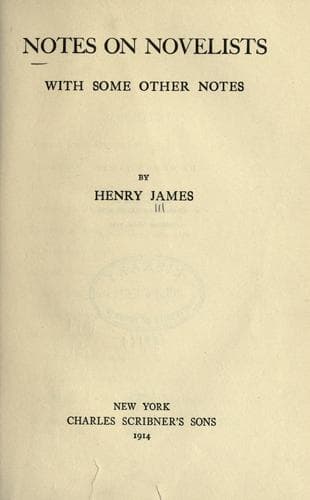
Notes on Novelists, with Some Other NotesJames, Henry
History
Notes on Novelists, with Some Other Notes
James, Henry
Fiction -- History and criticism; Novelists
conditions comparatively thankless—thoroughly, unweariedly, yet at the
same time ever so elegantly at play, and doing more for itself than it
succeeds in getting done for it. Than which nothing could be of a
greater reward to critical curiosity were it not still for the wonder of
wonders, a new page in the record altogether—the fact that these things
are apparently what the common reader has seen and understood. Great
then would seem to be after all the common reader!
IV
We must not fail of the point, however, that we have made these remarks
not at all with an eye to the question of whether “Chance” has been well
or ill inspired as to its particular choice of a way of really attending
to itself among all the possible alternatives, but only on the ground of
its having compared, selected and held on; since any alternative that
might have been preferred and that should have been effectively adopted
would point our moral as well—and this even if it is of profit none the
less to note the most striking of Mr. Conrad’s compositional
consequences. There is one of these that has had most to do with making
his pages differ in texture, and to our very first glance, from that
straggle of ungoverned verbiage which leads us up and down those of his
fellow fabulists in general on a vain hunt for some projected mass of
truth, some solidity of substance, as to which the deluge of “dialogue,”
the flooding report of things said, or at least of words pretendedly
spoken, shall have learned the art of being merely illustrational. What
first springs from any form of real attention, no matter which, we on a
comparison so made quickly perceive to be a practical challenge of the
preposterous pretension of this most fatuous of the luxuries of
looseness to acquit itself with authority of the structural and
compositional office. Infinitely valid and vivid as illustration, it
altogether depends for dignity and sense upon our state of possession of
its historic preliminaries, its promoting conditions, its supporting
ground; that is upon our waiting occupancy of the chamber it proposes to
light and which, when no other source of effect is more indicated, it
doubtless inimitably fills with life. Then its relation to what encloses
and confines and, in its sovereign interest, finely compresses it,
offering it constituted aspects, surfaces, presences, faces and figures
of the matter we are either generally or acutely concerned with to play
over and hang upon, then this relation gives it all its value: it has
flowered from the soil prepared and sheds back its richness into the
field of cultivation. It is interesting, in a word, only when nothing
else is equally so, carrying the vessel of the interest with least of a
stumble or a sacrifice; but it is of the essence that the sounds so set
in motion (it being as sound above all that they undertake to convey
sense,) should have something to proceed from, in their course, to
Public-domain text, read in full here on John Shaqi.
Reviews
Reviews
No reviews yet
Be the first to share your thoughts on this work.
Elsewhere in the archive
Join the Discussion
Join the discussion
Sign in to leave a comment or review.
Sign InorCreate an account