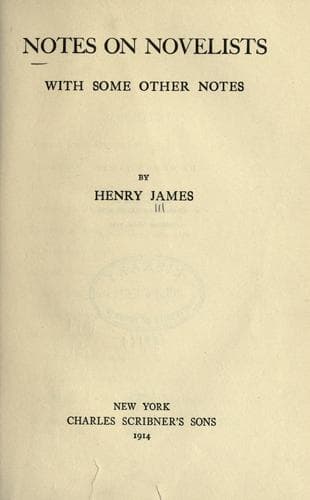
Notes on Novelists, with Some Other NotesJames, Henry
History
Notes on Novelists, with Some Other Notes
James, Henry
Fiction -- History and criticism; Novelists
It must always be remembered of him that he was the observer of a
special order of things, the moralist of a particular relation as the
umpire of a yacht-race is the legislator of a particular sport. His
vision and his talent, as I have said, were all for the immediate, for
the manners and the practices he himself was drenched with: he had none
of the faculty that scents from afar, that wings away and dips beyond
the horizon. There are moments when a reader not of his own race feels
that he simplifies almost absurdly. There are too many things he didn’t
after all guess, too many cases he didn’t after all provide for. He has
a certain odour of bad company that almost imperils his distinction.
This was doubtless the deepest of the reasons why among ourselves he
flourished so scantly: we felt ourselves to be of a world in which the
elements were differently mixed, the proportions differently marked, so
that the tables of our law would have to be differently graven. His very
earnestness was only a hindrance—he might have had more to say to us if
he had consented to have less application. This produced the curious
dryness, the obtrusive economy of his drama—the hammered sharpness of
every outline, the metallic ring of every sound. His terrible knowledge
suggested a kind of uniform—gilt buttons, a feathered hat and a little
official book; it was almost like an irruption of the police. The most
general masters are the poets, with all the things they blessedly don’t
hold for so very certain and all the things they blessedly and
preferably invent. It is true that Dumas was splendid, in his way,
exactly because he was not vague: his concentration, all confidence and
doctrine and epigram, is the explanation of his extraordinary force.
That force is his abiding quality: one feels that he was magnificently a
man—that he stands up high and sees straight and speaks loud. It is his
great temperament, undiminished by what it lacks, that endears him to
his admirers. It made him still of the greater race and played well its
part in its time—so well that one thinks of him finally as perhaps not,
when all is said, of the very happiest group, the group of those for
whom in the general affection there is yet more to come. He had an
immense reverberation—he practised the art that makes up for being the
most difficult by being the most acclaimed. There is no postponed poetic
justice for those who have had everything. He was seconded in a manner
that must have made success a double delight. There are indications that
the dramatist of the future will be less and less elated. He may well
become so if he is to see himself less and less interpreted.
THE NOVEL IN “THE RING AND THE BOOK”[8]
1912
Public-domain text, read in full here on John Shaqi.
Reviews
Reviews
No reviews yet
Be the first to share your thoughts on this work.
Elsewhere in the archive
Join the Discussion
Join the discussion
Sign in to leave a comment or review.
Sign InorCreate an account