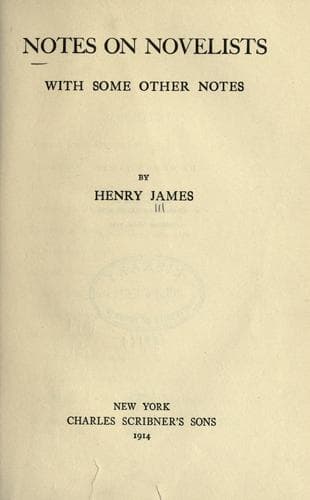
Notes on Novelists, with Some Other NotesJames, Henry
History
Notes on Novelists, with Some Other Notes
James, Henry
Fiction -- History and criticism; Novelists
All the good, however, that I recollect thinking of Dumas only reminds
me how little I desired that my remarks in general should lead me into
vain discriminations. There are some indeed that are not vain—at least
they help us to understand. He has a noble strain of force, a fulness of
blood that has permitted him to be tapped without shrinking. We must
speak of him in the present tense, as we always speak of the masters.
The theatre of his time, wherever it has been serious, has on the ground
of general method lived on him; wherever it has not done so it has not
lived at all. To pretend to be too shocked to profit by him was a way of
covering up its levity, but there was no escaping its fate. He was the
kind of artistic influence that is as inevitable as a medical specific:
you may decline it from black bottle to-day—you will take it from a
green bottle to-morrow. The energy that went forth blooming as Dumas has
come back grizzled as Ibsen, and would under the latter form, I am sure,
very freely acknowledge its debt. A critic whose words meet my eyes as I
write very justly says that: “Just as we have the novel before Balzac
and the novel after Balzac, the poetry that preceded Victor Hugo and the
poetry that followed him, so we have the drama before Alexandre Dumas
and the drama after him.” He has left his strong hand upon it; he
remodelled it as a vehicle, he refreshed it as an art. His passion for
it was obviously great, but there would be a high injustice to him in
not immediately adding that his interest in the material it dealt with,
in his subject, his question, his problem, was greater still than this
joy of the craftsman. That might well be, but there are celebrated cases
in which it has not been. The largest quality in Dumas was his immense
concern about life—his sense of human character and human fate as
commanding and controllable things. To do something on their behalf was
paramount for him, and _what_ to do in his own case clear: what else but
act upon the conscience as violently as he could, and with the
remarkable weapons that Providence had placed within his grasp and for
which he was to show his gratitude by a perfectly intrepid application?
These weapons were three: a hard rare wit, not lambent like a flame, but
stiff and straight like an arrow from a crossbow; a perception not less
rare of some of the realities of the particular human tendency about
which most falsities have clustered; and lastly that native instinct for
the conditions of dramatic presentation without which any attempt to
meet them is a helpless groping.
Public-domain text, read in full here on John Shaqi.
Reviews
Reviews
No reviews yet
Be the first to share your thoughts on this work.
Elsewhere in the archive
Join the Discussion
Join the discussion
Sign in to leave a comment or review.
Sign InorCreate an account