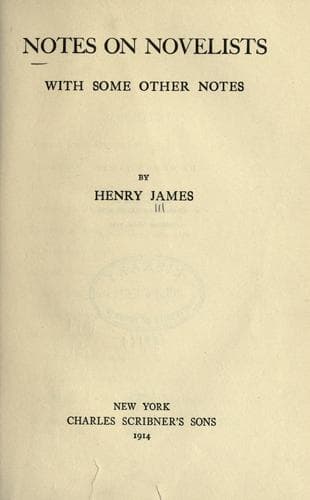
Notes on Novelists, with Some Other NotesJames, Henry
History
Notes on Novelists, with Some Other Notes
James, Henry
Fiction -- History and criticism; Novelists
From far back, from my first reading of these volumes, which took place
at the time of their disclosure to the world, when I was a fairly young
person, the sense, almost the pang, of the novel they might have
constituted sprang sharply from them; so that I was to go on through the
years almost irreverently, all but quite profanely if you will, thinking
of the great loose and uncontrolled composition, the great heavy-hanging
cluster of related but unreconciled parts, as a fiction of the so-called
historic type, that is as a suggested study of the manners and
conditions from which our own have more or less traceably issued, just
tragically spoiled—or as a work of art, in other words, smothered in
the producing. To which I hasten to add my consciousness of the scant
degree in which such a fresh start from our author’s documents, such a
reprojection of them, wonderful documents as they can only have been,
may claim a critical basis. Conceive me as simply astride of my
different fancy, my other dream, of the matter—which bolted with me, as
I have said, at the first alarm.
Browning worked in this connection literally _upon_ documents; no page
of his long story is more vivid and splendid than that of his find of
the Book in the litter of a market-stall in Florence and the swoop of
practised perception with which he caught up in it a treasure. Here was
a subject stated to the last ounce of its weight, a living and breathing
record of facts pitiful and terrible, a mass of matter bristling with
revelations and yet at the same time wrapped over with layer upon layer
of contemporary appreciation; which appreciation, in its turn, was a
part of the wealth to be appreciated. What our great master saw was his
situation founded, seated there in positively packed and congested
significance, though by just so much as it was charged with meanings and
values were those things undeveloped and unexpressed. They looked up at
him, even in that first flush and from their market-stall, and said to
him, in their compressed compass, as with the muffled rumble of a
slow-coming earthquake, “Express us, express us, immortalise us as we’ll
immortalise _you_!”—so that the terms of the understanding were so far
cogent and clear. It was an understanding, on their side, with the poet;
and since that poet had produced “Men and Women,” “Dramatic Lyrics,”
“Dramatis Personæ” and sundry plays—we needn’t even foist on him
“Sordello”—he could but understand in his own way. That way would have
had to be quite some other, we fully see, had he been by habit and
profession not just the lyric, epic, dramatic commentator, the
extractor, to whatever essential potency and redundancy, of the moral of
the fable, but the very fabulist himself, the inventor and projector,
layer down of the postulate and digger of the foundation. I doubt if we
have a precedent for this energy of appropriation of a deposit of
_stated_ matter, a block of sense already in position and requiring not
Public-domain text, read in full here on John Shaqi.
Reviews
Reviews
No reviews yet
Be the first to share your thoughts on this work.
Elsewhere in the archive
Join the Discussion
Join the discussion
Sign in to leave a comment or review.
Sign InorCreate an account