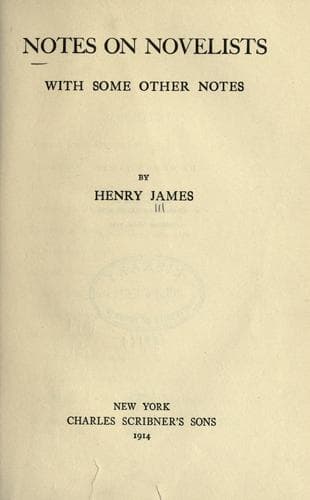
Notes on Novelists, with Some Other NotesJames, Henry
History
Notes on Novelists, with Some Other Notes
James, Henry
Fiction -- History and criticism; Novelists
to be shaped and squared and caused any further to solidify, but rather
to suffer disintegration, be pulled apart, melted down, hammered, by the
most characteristic of the poet’s processes, to powder—dust of gold and
silver, let us say. He was to apply to it his favourite system—that of
looking at his subject from the point of view of a curiosity almost
sublime in its freedom, yet almost homely in its method, and of
smuggling as many more points of view together into that one as the
fancy might take him to smuggle, on a scale on which even he had never
before applied it; this with a courage and a confidence that, in
presence of all the conditions, conditions many of them arduous and arid
and thankless even to defiance, we can only pronounce splendid, and of
which the issue was to be of a proportioned monstrous magnificence.
The one definite forecast for this product would have been that it
should figure for its producer as a poem—as if he had simply said, “I
embark at any rate for the Golden Isles”; everything else was of the
pure incalculable, the frank voyage of adventure. To what extent the
Golden Isles were in fact to be reached is a matter we needn’t pretend,
I think, absolutely to determine; let us feel for ourselves and as we
will about it—either see our adventurer, disembarked bag and baggage
and in possession, plant his flag on the highest eminence within his
circle of sea, or, on the other hand, but watch him approach and beat
back a little, tack and turn and stand off, always fairly in sight of
land, catching rare glimpses and meeting strange airs, but not quite
achieving the final _coup_ that annexes the group. He returns to us
under either view all scented and salted with his measure of contact,
and that for the moment is enough for us—more than enough for me at any
rate, engaged for your beguilement in this practical relation of
snuffing up what he brings. He brings, however one puts it, a detailed
report, which is but another word for a story; and it is with his story,
his offered, not his borrowed one—a very different matter—that I am
concerned. We are probably most of us so aware of its general content
that if I sum this up I may do so briefly. The Book of the Florentine
rubbish-heap is the full account (as full accounts were conceived in
those days) of the trial before the Roman courts, with inquiries and
judgments by the Tuscan authorities intermixed, of a certain Count Guido
Franceschini of Arezzo, decapitated, in company with four
confederates—these latter hanged—on February 22, 1698, for the murder
of his young wife Pompilia Comparini and her ostensible parents, Pietro
and Violante of that ilk.
Public-domain text, read in full here on John Shaqi.
Reviews
Reviews
No reviews yet
Be the first to share your thoughts on this work.
Elsewhere in the archive
Join the Discussion
Join the discussion
Sign in to leave a comment or review.
Sign InorCreate an account