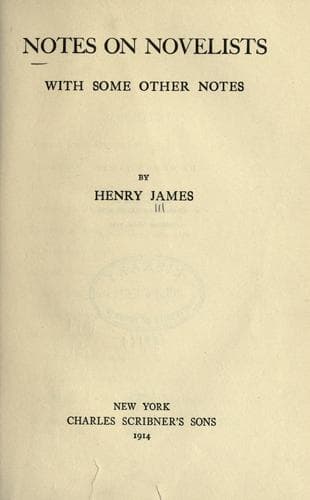
Notes on Novelists, with Some Other NotesJames, Henry
History
Notes on Novelists, with Some Other Notes
James, Henry
Fiction -- History and criticism; Novelists
right, all the while, if I recognise my suggested material, which keeps
coming and coming in the measure of my need, and my duty to which _is_
to recognise it, and as handsomely and actively as possible. The great
thing is that I have such a group of figures moving across so
constituted a scene—figures so typical, so salient, so reeking with the
old-world character, so impressed all over with its manners and its
morals, and so predestined, we see, to this particular horrid little
drama. And let me not be charged with giving it away, the idea of the
latent prose fiction, by calling it little and horrid; let me not—for
with my contention I can’t possibly afford to—appear to agree with
those who speak of the Franceschini-Comparini case as a mere vulgar
criminal anecdote.
It might have been such but for two reasons—counting only the principal
ones; one of these our fact that we see it so, I repeat, in Browning’s
inordinately-coloured light, and the other—which is indeed perhaps but
another face of the same—that, with whatever limitations, it gives us
in the rarest manner three characters of the first importance. I hold
three a great many; I could have done with it almost, I think, if there
had been but one or two; our rich provision shows you at any rate what I
mean by speaking of our author’s performance as above all a preparation
for something. Deeply he felt that with the three—the three built up at
us each with an equal genial rage of reiterative touches—there couldn’t
eventually not be something done (artistically done, I mean) if someone
would only do it. There they are in their old yellow Arezzo, that
miniature milder Florence, as sleepy to my recollection as a little
English cathedral city clustered about a Close, but dreaming not so
peacefully nor so innocently; there is the great fretted fabric of the
Church on which they are all swarming and grovelling, yet after their
fashion interesting parasites, from the high and dry old Archbishop,
meanly wise or ignobly edifying, to whom Pompilia resorts in her woe and
who practically pushes her way with a shuffling velvet foot; down
through the couple of Franceschini cadets, Canon Girolamo and Abate
Paul, mere minions, fairly in the verminous degree, of the overgrown
order or too-rank organism; down to Count Guido himself and to Canon
Caponsacchi, who have taken the tonsure at the outset of their careers,
but none too strictly the vows, and who lead their lives under some
strangest profanest pervertedest clerical category. There have been
before this the Roman preliminaries, the career of the queer Comparini,
the adoption, the assumption of the parentship, of the ill-starred
little girl, with the sordid cynicism of her marriage out of hand,
conveying her presumptive little fortune, her poor handful of even less
than contingent cash, to hungry middle-aged Count Guido’s stale “rank”;
the many-toned note or turbid harmony of all of which recurs to us in
Public-domain text, read in full here on John Shaqi.
Reviews
Reviews
No reviews yet
Be the first to share your thoughts on this work.
Elsewhere in the archive
Join the Discussion
Join the discussion
Sign in to leave a comment or review.
Sign InorCreate an account