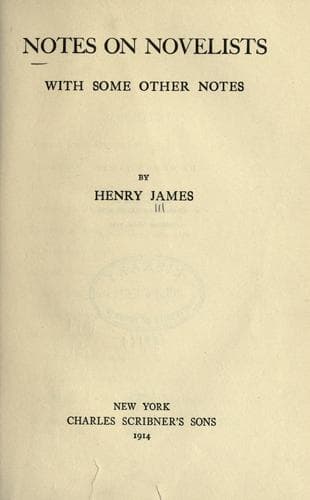
Notes on Novelists, with Some Other NotesJames, Henry
History
Notes on Novelists, with Some Other Notes
James, Henry
Fiction -- History and criticism; Novelists
say, a sound; Browning alone of them all is a temperature. We feel it,
we are in it at a plunge, with the very first pages of the thing before
us; to which, I confess, we surrender with a momentum drawn from fifty
of their predecessors, pages not less sovereign, elsewhere.
The old Florence of the late spring closes round us; the hand of Italy
is at once, with the recital of the old-world litter of Piazza San
Lorenzo, with that of the great glare and of the great shadow-masses,
heavy upon us, heavy with that strange weight, that mixed pressure,
which is somehow, to the imagination, at once a caress and a menace. Our
poet kicks up on the spot and at short notice what I have called his
cloud of gold-dust. I can but speak for myself at least—something that
I want to feel both as historic and esthetic truth, both as pictorial
and moral interest, something that will repay my fancy tenfold if I can
but feel it, hovers before me, and I say to myself that, whether or no a
great poem is to come off, I will be hanged if one of the vividest of
all stories and one of the sharpest of all impressions doesn’t. I beckon
these things on, I follow them up, I so desire and need them that I of
course, by my imaginative collaboration, contribute to them—from the
moment, that is, of my finding myself really in relation to the great
points. On the other hand, as certainly, it has taken the author of the
first volume, and of the two admirable chapters of the same—since I
can’t call them cantos—entitled respectively “Half-Rome” and “The Other
Half-Rome,” to put me in relation; where it is that he keeps me more and
more, letting the closeness of my state, it must be owned, occasionally
drop, letting the finer call on me even, for bad quarters-of-an-hour,
considerably languish, but starting up before me again in vivid
authority if I really presume to droop or stray. He takes his wilful way
with me, but I make it my own, picking over and over as I have said,
like some lingering talking pedlar’s client, his great unloosed pack;
and thus it is that by the time I am settled with Pompilia at Arezzo I
have lived into all the conditions. They press upon me close, those
wonderful dreadful beautiful particulars of the Italy of the eve of the
eighteenth century—Browning himself moving about, darting hither and
thither in them, at his mighty ease: beautiful, I say, because of the
quantity of romantic and esthetic tradition from a more romantic and
esthetic age still visibly, palpably, in solution there; and wonderful
and dreadful through something of a similar tissue of matchless and
ruthless consistencies and immoralities. I make to my hand, as this
infatuated reader, _my_ Italy of the eve of the eighteenth century—a
vast painted and gilded rococo shell roofing over a scenic, an amazingly
figured and furnished earth, but shutting out almost the whole of our
own dearly-bought, rudely-recovered spiritual sky. You see I have this
Public-domain text, read in full here on John Shaqi.
Reviews
Reviews
No reviews yet
Be the first to share your thoughts on this work.
Elsewhere in the archive
Join the Discussion
Join the discussion
Sign in to leave a comment or review.
Sign InorCreate an account