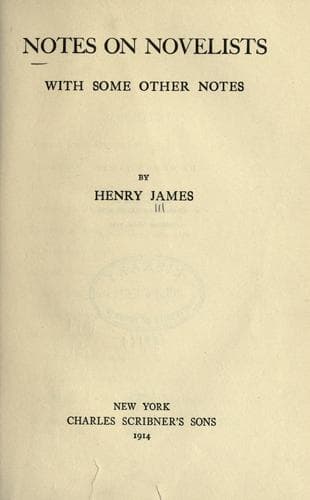
Notes on Novelists, with Some Other NotesJames, Henry
History
Notes on Novelists, with Some Other Notes
James, Henry
Fiction -- History and criticism; Novelists
I have spoken of the enveloping consciousness—or call it just the
struggling, emerging, comparing, at last intensely living conscience—of
Caponsacchi as the indicated centre of our situation or determinant of
our form, in the matter of the excellent novel; and know of course what
such an indication lets me in for, responsibly speaking, in the way of a
rearrangement of relations, in the way of liberties taken. To lift our
subject out of the sphere of anecdote and place it in the sphere of
drama, liberally considered, to give it dignity by extracting its finest
importance, causing its parts to flower together into some splendid
special sense, we supply it with a large lucid reflector, which we find
only, as I have already noted, in that mind and soul concerned in the
business that have at once the highest sensibility and the highest
capacity, or that are, as we may call it, most admirably agitated. There
is the awkward fact, the objector may say, that by our record the mind
and soul in question are not concerned till a given hour, when many
things have already happened and the climax is almost in sight; to which
we reply, at our ease, that we simply don’t suffer that fact to be
awkward. From the moment I am taking liberties I suffer _no_
awkwardness; I should be very helpless, quite without resource and
without vision, if I did. I said it to begin with: Browning works the
whole thing over—the whole thing as originally given him—and we work
_him_; helpfully, artfully, boldly, which is our whole blest basis. We
therefore turn Caponsacchi on earlier, ever so much earlier; turn him
on, with a brave ingenuity, from the very first—that is in Rome if need
be; place him there in the field, at once recipient and agent, vaguely
conscious and with splendid brooding apprehension, awaiting the
adventure of his life, awaiting his call, his real call (the others have
been such vain shows and hollow stopgaps), awaiting, in fine, his
terrible great fortune. His direct connection with Pompilia begins
certainly at Arezzo, only after she has been some time hideously
mismated and has suffered all but her direst extremity—that is of the
essence; we _take_ it; it’s all right. But his indirect participation is
another affair, and we get it—at a magnificent stroke—by the fact that
his view of Franceschini, his fellow-Aretine sordidly “on the make,” his
measure of undesired, indeed of quite execrated contact with him,
brushed against in the motley hungry Roman traffic, where and while that
sinister soul snuffs about on the very vague or the very foul scent of
_his_ fortune, may begin whenever we like. We have only to have it begin
right, only to make it, on the part of two men, a relation of strong
irritated perception and restless righteous convinced instinct in the
one nature and of equally instinctive hate and envy, jealousy and latent
fear, on the other, to see the indirect connection, the one with
Public-domain text, read in full here on John Shaqi.
Reviews
Reviews
No reviews yet
Be the first to share your thoughts on this work.
Elsewhere in the archive
Join the Discussion
Join the discussion
Sign in to leave a comment or review.
Sign InorCreate an account