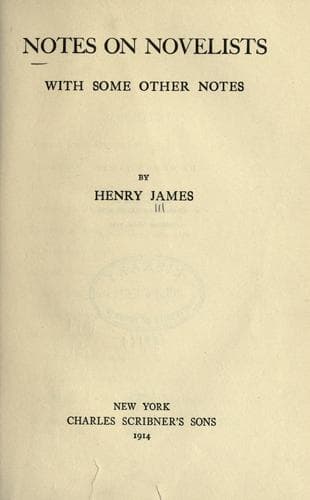
Notes on Novelists, with Some Other NotesJames, Henry
History
Notes on Novelists, with Some Other Notes
James, Henry
Fiction -- History and criticism; Novelists
Pompilia, as I say, throw across our page as portentous a shadow as we
need. Then we get Caponsacchi as a recipient up to the brim—as an
agent, a predestined one, up to the hilt. I can scarce begin to tell you
what I see him give, as we say, or how his sentient and observational
life, his fine reactions in presence of such a creature as Guido, such a
social type and image and lurid light, as it were, make him
comparatively a modern man, breathed upon, to that deep and interesting
agitation I have mentioned, by more forces than he yet reckons or knows
the names of.
The direct relation—always to Pompilia—is made, at Arezzo, as we know,
by Franceschini himself; preparing his own doom, in the false light of
his debased wit, by creating an appearance of hidden dealing between his
wife and the priest which shall, as promptly as he likes—if he but work
it right—compromise and overwhelm them. The particular deepest
damnation he conceives for his weaker, his weakest victim is that she
shall take the cleric Caponsacchi for her lover, he indubitably
willing—to Guido’s apprehension; and that her castigation at his hands
for this, sufficiently proved upon her, shall be the last luxury of his
own baseness. He forges infernally, though grossly enough, an imputed
correspondence between them, as series of love-letters, scandalous
scrawls, of the last erotic intensity; which we in the event see
solemnly weighed by his fatuous judges, all fatuous save the grave old
Pope, in the scale of Pompilia’s guilt and responsibility. It is this
atrocity that at the _dénouement_ damns Guido himself most, or
well-nigh; but if it fails and recoils, as all his calculations do—it
is only his rush of passion that doesn’t miss—this is by the fact
exactly that, as we have seen, his wife and her friend are, for our
perfect persuasion, characters of the deepest dye. There, if you please,
is the finest side of our subject; such sides come up, such sides flare
out upon us, when we get such characters in such embroilments. Admire
with me therefore our felicity in this first-class value of Browning’s
beautiful critical genial vision of his Caponsacchi—vision of him as
the tried and tempered and illuminated _man_, a great round smooth,
though as yet but little worn gold-piece, an embossed and figured ducat
or sequin of the period, placed by the poet in my hand. He gives me that
value to spend for him, spend on all the strange old experience, old
sights and sounds and stuffs, of the old stored Italy—so we have at
least the wit to spend it to high advantage; which is just what I mean
by our taking the liberties we spoke of. I see such bits we can get with
it; but the difficulty is that I see so many more things than I can have
even dreamed of giving you a hint of. I see the Arezzo life and the
Arezzo crisis with every “i” dotted and every circumstance presented;
and when Guido takes his wife, as a possible trap for her, to the
Public-domain text, read in full here on John Shaqi.
Reviews
Reviews
No reviews yet
Be the first to share your thoughts on this work.
Elsewhere in the archive
Join the Discussion
Join the discussion
Sign in to leave a comment or review.
Sign InorCreate an account