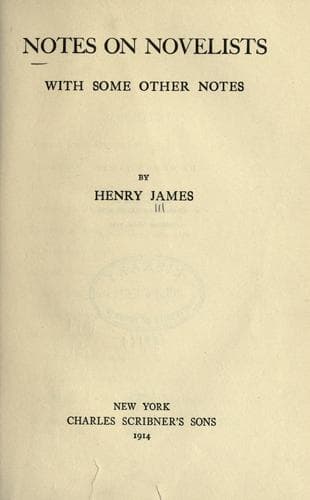
Notes on Novelists, with Some Other NotesJames, Henry
History
Notes on Novelists, with Some Other Notes
James, Henry
Fiction -- History and criticism; Novelists
I gladly embrace the occasion to devote a few words to the honoured
memory of my distinguished friend the late Charles Eliot Norton, who,
dying at Cambridge, Massachusetts, on the 21st of October last, after
having reached his eightieth year, had long occupied—and with an
originality of spirit and a beneficence of effect all his own—the chair
of the History of the Fine Arts at Harvard University, as well as, in
the view of the American world surrounding that seat of influence, the
position of one of the most accomplished of scholars and most efficient
of citizens. This commemorative page may not disclaim the personal tone,
for I can speak of Charles Norton but in the light of an affection which
began long years ago, even though my part in our relation had to be, for
some time, markedly that of a junior; of which tie I was to remain ever
after, despite long stretches of material separation, a conscious and
grateful beneficiary. I can speak of him therefore as I happened myself
to see and know him—with interest and sympathy acting, for considerable
periods together, across distances and superficial differences, yet with
the sense of his extremely individual character and career suffering no
abatement, and indeed with my impression of the fine consistency and
exemplary value of these things clear as never before.
I find this impression go back for its origin very far—to one autumn
day when, an extremely immature aspirant to the rare laurel of the
critic, I went out from Boston to Cambridge to offer him a contribution
to the old, if I should not rather say the then middle-aged, “North
American Review,” of which he had recently undertaken the editorship. I
already knew him a little, enough to have met casual kindness at his
hands; but my vision of his active presence and function, in the
community that had happily produced and that was long to enjoy him,
found itself, I think, completely constituted at that hour, with scarce
an essential touch to be afterwards added. He largely developed and
expanded as time went on; certain more or less local reserves and
conservatisms fell away from him; but his temper and attitude, all his
own from the first, were to give a singular unity to his life. This
intensity of perception on his young visitor’s part may perhaps have
sprung a little from the fact that he accepted on the spot, as the
visitor still romantically remembers, a certain very first awkward essay
in criticism, and was to publish it in his forthcoming number; but I
little doubt whether even had he refused it the grace of the whole
occasion would have lost anything to my excited view, and feel sure that
the interest in particular would have gained had he charmingly put
before me (as he would have been sure to do) the ground of his
discrimination. For his eminent character as a “representative of
culture” announced itself exactly in proportion as one’s general sense
of the medium in which it was to be exerted was strong; and I seem
Public-domain text, read in full here on John Shaqi.
Reviews
Reviews
No reviews yet
Be the first to share your thoughts on this work.
Elsewhere in the archive
Join the Discussion
Join the discussion
Sign in to leave a comment or review.
Sign InorCreate an account