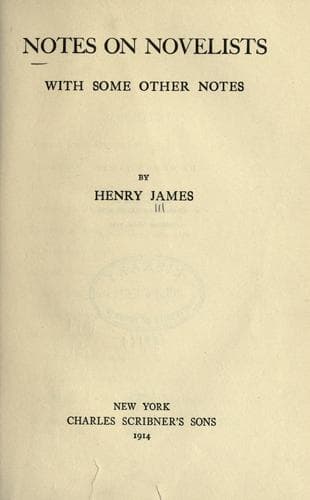
Notes on Novelists, with Some Other NotesJames, Henry
History
Notes on Novelists, with Some Other Notes
James, Henry
Fiction -- History and criticism; Novelists
passivity from the high plane, for our pair of protagonists, of
constructive, of heroic vision, this is not a blur from the time
everything that happens happens most effectively to Caponsacchi’s life.
Pompilia’s is taken, but she is none the less given; and it is in his
consciousness and experience that she most intensely flowers—with all
her jubilation for doing so. So that _he_ contains the whole—unless
indeed after all the Pope does, the Pope whom I was leaving out as too
transcendent for _our_ version. Unless, unless, further and further, I
see what I have at this late moment no right to; see, as the very end
and splendid climax of all, Caponsacchi sent for to the Vatican and
admitted alone to the Papal presence. _There_ is a scene if we will; and
in the mere mutual confrontation, brief, silent, searching, recognising,
consecrating, almost as august on the one part as on the other. It
rounds us off; but you will think I stray too far. I have wanted, alas,
to say such still other fond fine things—it being of our poet’s great
nature to prompt them at every step—that I almost feel I have missed
half my points; which will doubtless therefore show you these remarks in
their nakedness. Take them and my particular contention as a pretext and
a minor affair if you will only feel them at the same time as at the
worst a restless refinement of homage. It has been easy in many another
case to run to earth the stray prime fancy, the original anecdote or
artless tale, from which a great imaginative work, starting off after
meeting it, has sprung and rebounded again and soared; and perhaps it is
right and happy and final that one should have faltered in attempting by
a converse curiosity to clip off or tie back the wings that once have
spread. You will agree with me none the less, I feel, that Browning’s
great generous wings are over us still and even now, more than ever now;
and also that they shake down on us his blessing.
-----
Footnote 8:
Address delivered before the Academic Committee of the Royal Society of
Literature in Commemoration of the Centenary of Robert Browning, May 7,
1912.
AN AMERICAN ART-SCHOLAR: CHARLES ELIOT NORTON
1908
Public-domain text, read in full here on John Shaqi.
Reviews
Reviews
No reviews yet
Be the first to share your thoughts on this work.
Elsewhere in the archive
Join the Discussion
Join the discussion
Sign in to leave a comment or review.
Sign InorCreate an account