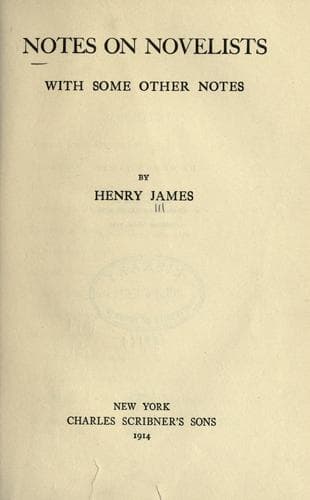
Notes on Novelists, with Some Other NotesJames, Henry
History
Notes on Novelists, with Some Other Notes
James, Henry
Fiction -- History and criticism; Novelists
I am afraid the interest of the world of native letters is not at this
moment so great as to make us despise mere translation as an aid to
curiosity. There is indeed no reason why we should forbear to say in
advance what we are certain, every time, to say after (after the heat
has cooled I mean:) namely, that nothing is easier to concede than that
Ibsen—contentious name!—would be much less remarked if he were one of
a dozen. It is impossible, in London at least, to shut one’s eyes to the
fact that if to so many ingenious minds he is a kind of pictorial
monster, a grotesque on the sign of a side-show, this is at least partly
because his form has a monstrous rarity. It is one of the odd things of
our actual esthetics that the more theatres multiply the less any one
reads a play—the less any one cares, in a word, for the text of the
adventure. That no one ever _does_ read a play has long been a
commonplace of the wisdom of booksellers. Ibsen, however, is a text, and
Ibsen is read, and Ibsen contradicts the custom and confounds the
prejudice; with the effect thereby, in an odd way, of being doubly an
exotic. His violent substance imposes, as it were, his insidious form;
it is not (as would have seemed more likely) the form that imposes the
substance. Mr. William Archer has just published his version of “John
Gabriel Borkman,” of which, moreover, French and German versions reach
us at the same moment. There are therefore all the elements of a fresh
breeze in the wind—one has already a sense as of a cracking of whips
and a girding of loins. You may by this time be terribly tired of it all
in America; but, as I mentioned a fortnight ago, we have had very recent
evidence that languor here, in this connection, is by no means as yet
the dominant note. It is not the dispute itself, however, that most
interests me: let me pay it, for what it has been and what it still may
be, the mere superficial tribute of saying that it constitutes one of
the very few cases of contagious discussion of a matter not political, a
question not of mere practice, of which I remember to have felt, in a
heavy air, the engaging titillation. In London generally, I think, the
wandering breath of criticism is the stray guest at the big party—the
shy young man whom nobody knows. In this remarkable instance the shy
young man has ventured to pause and hover, has lighted on a topic,
introduced himself and, after a gasp of consternation in the company,
seen a little circle gather round him. I can only speak as one of the
little circle, testifying to my individual glee.
Public-domain text, read in full here on John Shaqi.
Reviews
Reviews
No reviews yet
Be the first to share your thoughts on this work.
Elsewhere in the archive
Join the Discussion
Join the discussion
Sign in to leave a comment or review.
Sign InorCreate an account