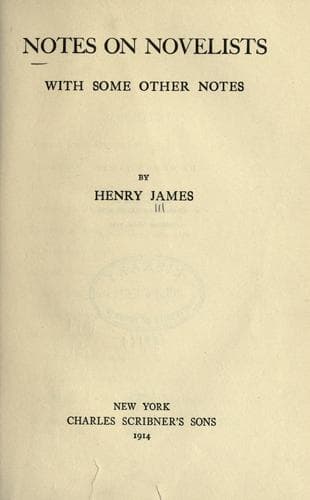
Notes on Novelists, with Some Other NotesJames, Henry
History
Notes on Novelists, with Some Other Notes
James, Henry
Fiction -- History and criticism; Novelists
The author who at the age of seventy, a provincial of provincials, turns
out “John Gabriel” is frankly for me so much one of the peculiar
pleasures of the day, one of the current strong sensations, that, erect
as he seems still to stand, I deplore his extreme maturity and, thinking
of what shall happen, look round in vain for any other possible source
of the same kind of emotion. For Ibsen strikes me as an extraordinary
curiosity, and every time he sounds his note the miracle to my
perception is renewed. I call it a miracle because it is a result of so
dry a view of life, so indifferent a vision of the comedy of things. His
idea of the thing represented is never the comic idea, though this is
evidently what it often only can be for many of his English readers and
spectators. Comedy moreover is a product mainly of observation, and I
scarcely know what to say of his figures except that they haven’t the
_signs_. The answer to that is doubtless partly that they haven’t the
English, but have the Norwegian. In such a case one of the Norwegian
must be in truth this very lack of signs.
They have no tone but their moral tone. They are highly animated
abstractions, with the extraordinary, the brilliant property of becoming
when represented at once more abstract and more living. If the spirit is
a lamp within us, glowing through what the world and the flesh make of
us as through a ground-glass shade, then such pictures as Little Eyolf
and John Gabriel are each a _chassez-croisez_ of lamps burning, as in
tasteless parlours, with the flame practically exposed. There are no
shades in the house, or the Norwegian ground-glass is singularly clear.
There is a positive odour of spiritual paraffin. The author nevertheless
arrives at the dramatist’s great goal—he arrives for all his meagreness
at intensity. The meagreness, which is after all but an unconscious, an
admirable economy, never interferes with that: it plays straight into
the hands of his rare mastery of form. The contrast between this
form—so difficult to have reached, so “evolved,” so civilised—and the
bareness and bleakness of his little northern democracy is the source of
half the hard frugal charm that he puts forth. In the cold fixed light
of it the notes we speak of as deficiencies take a sharp value in the
picture. There is no small-talk, there are scarcely any manners. On the
other hand there is so little vulgarity that this of itself has almost
the effect of a deeper, a more lonely provincialism. The background at
any rate is the sunset over the ice. Well in the very front of the scene
lunges with extraordinary length of arm the Ego against the Ego, and
rocks in a rigour of passion the soul against the soul—a spectacle, a
movement, as definite as the relief of silhouettes in black paper or of
a train of Eskimo dogs on the snow. Down from that desolation the sturdy
old symbolist comes this time with a supreme example of his method. It
Public-domain text, read in full here on John Shaqi.
Reviews
Reviews
No reviews yet
Be the first to share your thoughts on this work.
Elsewhere in the archive
Join the Discussion
Join the discussion
Sign in to leave a comment or review.
Sign InorCreate an account