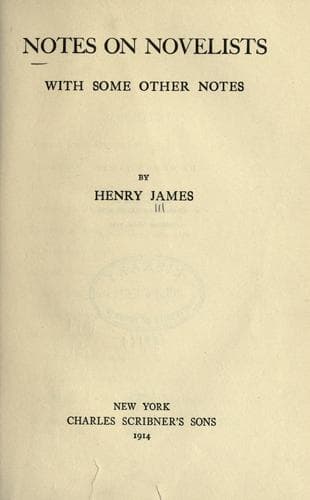
Notes on Novelists, with Some Other NotesJames, Henry
History
Notes on Novelists, with Some Other Notes
James, Henry
Fiction -- History and criticism; Novelists
is a high wonder and pleasure to welcome such splendid fruit from sap
that might by now have shown something of the chill of age. Never has he
juggled more gallantly with difficulty and danger than in this really
prodigious “John Gabriel,” in which a great span of tragedy is taken
between three or four persons—a trio of the grim and grizzled—in the
two or three hours of a winter’s evening; in which the whole thing
throbs with an actability that fairly shakes us as we read; and in
which, as the very flower of his artistic triumph, he has given us for
the most beautiful and touching of his heroines a sad old maid of sixty.
Such “parts,” even from the vulgarest point of view, are Borkman and
Ella Rentheim.
LONDON NOTES
_June_ 1897
I am afraid there are at this moment only two notes for a communication
from London to strike. One is that of the plunge into the deep and
turbid waters of the Jubilee; the other is that of the inevitable
retreat from them—the backward scramble up the bank and scurry over its
crest and out of sight. London is in a sorry state; nevertheless I judge
that the number of persons about to arrive undaunted will not fall
substantially short of the number of horror-stricken fugitives. Not to
depart is practically to arrive; for there is little difference in the
two kinds of violence, the shock you await or the shock that awaits you.
Let me hasten, however, to declare that—to speak for the present only
of the former of these—the prospect is full of suggestion, the affair
promises a rare sort of interest. It began a fortnight since to be
clear—and the certitude grows each day—that we are to be treated to a
revelation really precious, the domestic or familiar vision, as it were,
the back-stairs or underside view, of a situation that will rank as
celebrated. Balzac’s image of _l’envers de l’histoire contemporaine_ is
in fact already under our nose, already offered us in a big bouncing
unmistakable case. We brush with an irreverent hand the back of the
tapestry—we crawl on unabashed knees under the tent of the circus. The
commemoration of the completed sixtieth year of her Majesty’s reign will
figure to the end of time in the roll of English wonders and can
scarcely fail to hold its own as an occasion unparalleled. And yet we
touch it as we come and go—we feel it mainly as a great incommodity. It
has already so intimate, so ugly, so measurable a side that these
impressions begin to fall into their place with a kind of representative
force, to figure as a symbol of the general truth that the principal
pomps and circumstances of the historic page have had their most intense
existence as material and social arrangements, disagreeable or amusing
accidents, affecting the few momentary mortals at that time in the
neighbourhood. The gross defacement of London, the uproarious traffic in
seats, the miles of unsightly scaffolding between the West End and the
Public-domain text, read in full here on John Shaqi.
Reviews
Reviews
No reviews yet
Be the first to share your thoughts on this work.
Elsewhere in the archive
Join the Discussion
Join the discussion
Sign in to leave a comment or review.
Sign InorCreate an account