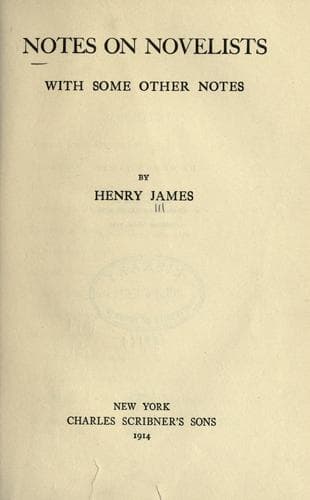
Notes on Novelists, with Some Other NotesJames, Henry
History
Notes on Novelists, with Some Other Notes
James, Henry
Fiction -- History and criticism; Novelists
The foremost, the immense impression is of course the constant, the
permanent, the ever-supreme—the impression of that greatest glory of
our race, its passionate feeling for trade. I doubt if the commercial
instinct be not, as London now feels it throb and glow, quite as
striking as any conceivable projection of it that even our American
pressure of the pump might, at the highest, produce. That is the real
tent of the circus—that is the real back of the tapestry. There have
long, I know, been persons ready to prove by book that the explanation
of the “historical event” has always been somebody’s desire to make
money; never, at all events, from the near view, will that explanation
have covered so much of the ground. No result of the fact that the Queen
has reigned sixty years—no sort of sentimental or other association
with it—begins to have the air of coming home to the London conscience
like this happy consequence of the chance in it to sell something dear.
As yet that chance is the one sound that fills the air, and will
probably be the only note audibly struck till the plaudits of the day
itself begin to substitute, none too soon, a more mellifluous one. When
the people are all at the windows and in the trees and on the
water-spouts, house-tops, scaffolds and other ledges and coigns of
vantage set as traps for them by the motive power, _then_ doubtless
there will be another aspect to reckon with—then we shall see, of the
grand occasion, nothing but what is decently and presentably historic.
All I mean is that, pending the apotheosis, London has found in this
particular chapter of the career of its aged sovereign only an enormous
selfish advertisement. It came to me the other day in a quoted epigram
that the advertisement shows as far off as across the Channel and all
the way to Paris, where one of the reflections it has suggested—as it
must inevitably suggest many—appears to be that, in contrast, when, a
year ago, the Russian sovereigns were about to arrive no good Parisian
thought for a moment of anything but how he could most work for the
adornment of his town. I dare say that in fact from a good Parisian or
two a window or a tree was to be hired; but the echo is at least
interesting _as_ an echo, not less than as a reminder of how we still
wait here for the outbreak of the kind of enthusiasm that shall take the
decorative form. The graceful tip of its nose has, it must be admitted,
yet to show. But there are other sides still, and one of them
immense—the light we may take as flooding, I mean, the whole question
of the solidity of the throne. It is impossible to live long in England
without feeling that the monarchy is—below-ground, so to speak, in
particular—a rock; but it was reserved for these days to accentuate the
immobility of even that portion of the rock which protrudes above the
surface. It is being tested in a manner by fire, and it resists with a
vitality nothing short of prophetic. The commercial instinct, as I say,
Public-domain text, read in full here on John Shaqi.
Reviews
Reviews
No reviews yet
Be the first to share your thoughts on this work.
Elsewhere in the archive
Join the Discussion
Join the discussion
Sign in to leave a comment or review.
Sign InorCreate an account