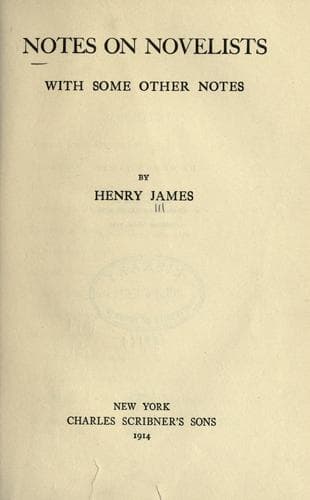
Notes on Novelists, with Some Other NotesJames, Henry
History
Notes on Novelists, with Some Other Notes
James, Henry
Fiction -- History and criticism; Novelists
perches upon it with a security and a success that banish a rival from
the field. It is the biggest of all draws for the biggest of all
circuses; it will bring more money to more doors than anything that can
be imagined in its place. It will march through the ages unshaken. The
coronation of a new sovereign is an event, at the worst, well within the
compass of the mind, and what will that bring with it so much as a fresh
lively market and miles of new posters and new carpentry? Then, who
knows?—coronations will, for a stretch and a change perhaps, be more
frequent than anniversaries; and the bargains struck over the last will,
again at the worst, carry an hilarious country well on to the next. Has
not the monarchy moreover—besides thus periodically making trade
roar—the lively merit, for such an observer as I fancy considering
these things, of helping more than anything else the answers to the
questions into which our actual curiosity most overflows; the question
for instance of whether in the case before us the triumph of vulgarity
be not precisely the flushed but muscular triumph of the inevitable? If
vulgarity thrones now on the house-tops, “blown” and red in the face, is
it not because it has been pushed aloft by deep forces and is really
after all itself the show? The picturesque at any rate has to meet the
conditions. We miss, we regret the old “style” of history; but the style
would, I think, be there if we let it: the age has a manner of its own
that disconcerts, that swamps it. The age is the loudest thing of all.
What has altered is simply the conditions. Poor history has to meet
them, these conditions; she must accommodate herself. She must accept
vulgarity or perish. Some day doubtless she _will_ perish, but for a
little while longer she remembers and struggles. She becomes indeed, as
we look up Piccadilly in the light of this image, perhaps rather more
dramatic than ever—at any rate more pathetic, more noble in her choked
humiliation. Then even as we pity her we try perhaps to bring her round,
to make her understand a little better. We try to explain that if we are
dreadful to deal with it is only, really, a good deal because we so
detestably grow and grow. There is so horribly much of us—that’s where
_our_ style breaks down. Small crowds and paltry bargains didn’t matter,
and a little vulgarity—just a very little—could in other times manage
to pass. Our shame, alas, is our quantity.
Public-domain text, read in full here on John Shaqi.
Reviews
Reviews
No reviews yet
Be the first to share your thoughts on this work.
Elsewhere in the archive
Join the Discussion
Join the discussion
Sign in to leave a comment or review.
Sign InorCreate an account