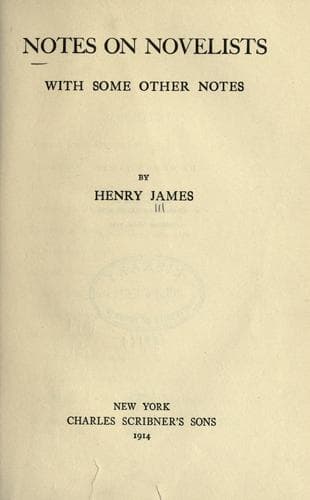
Notes on Novelists, with Some Other NotesJames, Henry
History
Notes on Novelists, with Some Other Notes
James, Henry
Fiction -- History and criticism; Novelists
I found, on the morrow in question—the great day had been the 22nd—the
main suggestion of a journey from the south of England up to Waterloo
and across from Waterloo to Paddington to be that of one of those deep
gasps or wild staggers, losses of wind and of balance, that follow some
tremendous effort or some violent concussion. The weather was splendid
and torrid and London a huge dusty cabless confusion of timber already
tottering, of decorations already stale, of _badauds_ already bored. The
banquet-hall was by no means deserted, but it was choked with mere
echoes and candle-ends; one had heard often enough of a “great national
awakening,” and this was the greatest it would have been possible to
imagine. Millions of eyes, opening to dust and glare from the scenery of
dreams, seemed slowly to stare and to try to recollect. Certainly at
that distance the omens were poor for such concentration as a French
critic might have been moved to count upon, and even on reaching Oxford
I was met by the sense that the spirit of that seat of learning, though
accustomed to intellectual strain, had before the afternoon but little
of a margin for pulling itself together. Let me say at once that it made
the most of the scant interval and that when five o’clock came the bare
scholastic room at the Taylorian offered M. Bourget’s reputation and
topic, in the hot dead Oxford air, an attention as deep and as
many-headed as the combination could ever have hoped to command.
For one auditor of whom I can speak, at all events, the occasion had an
intensity of interest transcending even that of Flaubert’s strange
personal story—which was part of M. Bourget’s theme—and of the new and
deep meanings that the lecturer read into it. Just the fact of the
occasion itself struck me as having well-nigh most to say, and at any
rate fed most the all but bottomless sense that constitutes to-day my
chief receptacle of impressions; a sense which at the same time I fear I
cannot better describe than as that of the way we are markedly going. No
undue eagerness to determine whether this be well or ill attaches to the
particular consciousness I speak of, and I can only give it frankly for
what, on the whole, it most, for beguilement, for amusement, for the
sweet thrill of perception, represents and achieves—the quickened
notation of our “modernity.” I feel that I can pay this last-named
lively influence no greater tribute than by candidly accepting as an aid
to expression its convenient name. To do that doubtless is to accept
with the name a host of other things. From the moment, at any rate, the
quickening I speak of sets in it is wonderful how many of these other
things play, by every circumstance, into the picture.
Public-domain text, read in full here on John Shaqi.
Reviews
Reviews
No reviews yet
Be the first to share your thoughts on this work.
Elsewhere in the archive
Join the Discussion
Join the discussion
Sign in to leave a comment or review.
Sign InorCreate an account