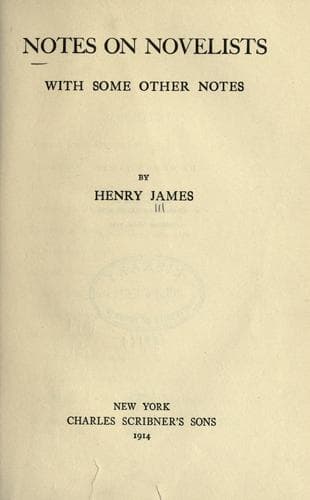
Notes on Novelists, with Some Other NotesJames, Henry
History
Notes on Novelists, with Some Other Notes
James, Henry
Fiction -- History and criticism; Novelists
It is well to content one’s self, at all events, with affection; so
stiff a job, in such a case, is understanding or, still more,
explanation. There is a kind of finality in Loti’s simplicity—if it
even _be_ simplicity. He performs in an air in which, on the part of the
spectator, analysis withers and only submission lives. Has it anything
to do with literature? Has it anything to do with nature? It must be, we
should suppose, the last refinement either of one or of the other. Is it
all emotion, is it all calculation, is it all truth, is it all humbug?
All we can say as readers is that it is for ourselves all experience,
and of the most personal intensity. The great question is whether it be
emotion “neat” or emotion rendered and reduced. If it be resolved into
art why hasn’t it more of the chill? If it be sensibility pure why isn’t
it cruder and clumsier? What is exquisite is the contact of sensibility
made somehow so convenient—with only the beauty preserved. It is not
too much to say of Loti that his sensibility begins where that of most
of those who _use_ the article ends. If moreover in effect he represents
the triumph of instinct, when was instinct ever so sustained and so
unerring? It keeps him unfailingly, in the matter of “dialogue,” out of
the overflow and the waste. It is a joy to see how his looseness is
pervaded after all by proportion.
LONDON NOTES
_August_ 1897
I shrink at this day from any air of relapsing into reference to those
Victorian saturnalia of which the force may now be taken as pretty well
spent; and if I remount the stream for an instant it is but with the
innocent intention of plucking the one little flower of literature that,
while the current roared, happened—so far at least as I could
observe—to sprout by the bank. If it was sole of its kind moreover it
was, I hasten to add, a mere accident of the Jubilee and as little a
prominent as a preconcerted feature. What it comes to therefore is that
if I gathered at the supreme moment a literary impression, the literary
impression had yet nothing to do with the affair; nothing, that is,
beyond the casual connection given by a somewhat acrid aftertaste, the
vision of the London of the morrow as I met this experience in a woeful
squeeze through town the day after the fair. It was the singular fate of
M. Paul Bourget, invited to lecture at Oxford under university patronage
and with Gustave Flaubert for his subject, to have found his appearance
arranged for June 23. I express this untowardness but feebly, I know,
for those at a distance from the edge of the whirlpool, the vast
concentric eddies that sucked down all other life.
Public-domain text, read in full here on John Shaqi.
Reviews
Reviews
No reviews yet
Be the first to share your thoughts on this work.
Elsewhere in the archive
Join the Discussion
Join the discussion
Sign in to leave a comment or review.
Sign InorCreate an account