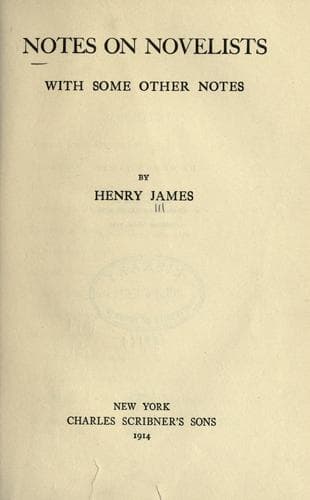
Notes on Novelists, with Some Other NotesJames, Henry
History
Notes on Novelists, with Some Other Notes
James, Henry
Fiction -- History and criticism; Novelists
Criticism, among us all, has come to the pass of being shy of difficult
cases, and no one, for that matter, practised it more in the hit-or-miss
fashion and on happy-go-lucky lines than Mrs. Oliphant herself. She
practised it, as she practised everything, on such an inordinate scale
that her biographer, if there is to be one, will have no small task in
the mere drafting of lists of her contributions to magazines and
journals in general and to “Blackwood” in particular. She wrought in
“Blackwood” for years, anonymously and profusely; no writer of the day
found a _porte-voix_ nearer to hand or used it with an easier personal
latitude and comfort. I should almost suppose in fact that no woman had
ever, for half a century, had her personal “say” so publicly and
irresponsibly. Her facilities of course were of her own making, but the
wonder was that once made they could be so applied.
The explanation of her extraordinary fecundity was a rare original
equipment, an imperturbability of courage, health and brain, to which
was added the fortune or the merit of her having had to tune her
instrument at the earliest age. That instrument was essentially a Scotch
one; her stream flowed long and full without losing its primary colour.
To say that she was organised highly for literature would be to make too
light of too many hazards and conditions; but few writers of our time
have been so organised for liberal, for—one may almost put it—heroic
production. One of the interesting things in big persons is that they
leave us plenty of questions, if only about themselves; and precisely
one of those that Mrs. Oliphant suggests is the wonder and mystery of a
love of letters that could be so great without ever, on a single
occasion even, being greater. It was of course not a matter of mere
love; it was a part of her volume and abundance that she understood life
itself in a fine freehanded manner and, I imagine, seldom refused to
risk a push at a subject, however it might have given pause, that would
help to turn her wide wheel. She worked largely from obligation—to meet
the necessities and charges and pleasures and sorrows of which she had a
plentiful share. She showed in it all a sort of sedentary dash—an
acceptance of the day’s task and an abstention from the plaintive note
from which I confess I could never withhold my admiration.
Public-domain text, read in full here on John Shaqi.
Reviews
Reviews
No reviews yet
Be the first to share your thoughts on this work.
Elsewhere in the archive
Join the Discussion
Join the discussion
Sign in to leave a comment or review.
Sign InorCreate an account