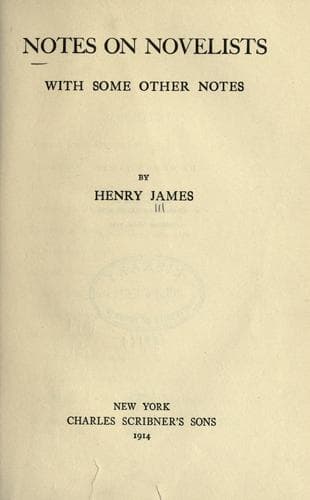
Notes on Novelists, with Some Other NotesJames, Henry
History
Notes on Novelists, with Some Other Notes
James, Henry
Fiction -- History and criticism; Novelists
Her capacity for labour was infinite—for labour of the only sort that,
with the fine strain of old Scotch pride and belated letterless toryism
that was in her, she regarded as respectable. She had small patience
with new-fangled attitudes or with a finical conscience. What was good
enough for Sir Walter was good enough for her, and I make no doubt that
her shrewd unfiltered easy flow, fed after all by an immensity of
reading as well as of observation and humour, would have been good
enough for Sir Walter. If this had been the case with her abounding
history, biography and criticism, it would have been still more the case
with her uncontrolled flood of fiction. She was really a great
_improvisatrice_, a night-working spinner of long, loose, vivid yarns,
numberless, pauseless, admirable, repeatedly, for their full, pleasant,
reckless rustle over depths and difficulties—admirable indeed, in any
case of Scotch elements, for many a close engagement with these. She
showed in no literary relation more acuteness than in the relation—so
profitable a one as it has always been—to the inexhaustible little
country which has given so much, yet has ever so much more to give, and
all the romance and reality of which she had at the end of her pen. Her
Scotch folk have a wealth of life, and I think no Scotch talk in fiction
less of a strain to the patience of the profane. It may be less
austerely veracious than some—but these are esoteric matters.
Reading since her death “Kirsteen”—one of the hundred, but published in
her latest period and much admired by some judges—I was, though
beguiled, not too much beguiled to be struck afresh with that elusive
fact on which I just touched, the mixture in the whole thing. Such a
product as “Kirsteen” has life—is full of life, but the critic is
infinitely baffled. It may of course be said to him that he has nothing
to do with compositions of this order—with such wares altogether as
Mrs. Oliphant dealt in. But he can accept that retort only with a
renunciation of some of his liveliest anxieties. Let him take some early
day for getting behind, as it were, the complexion of a talent that
could care to handle a thing to the tune of so many pages and yet not
care more to “do” it. There is a fascination in the mere spectacle of so
serene an instinct for the middle way, so visible a conviction that to
reflect is to be lost.
Public-domain text, read in full here on John Shaqi.
Reviews
Reviews
No reviews yet
Be the first to share your thoughts on this work.
Elsewhere in the archive
Join the Discussion
Join the discussion
Sign in to leave a comment or review.
Sign InorCreate an account