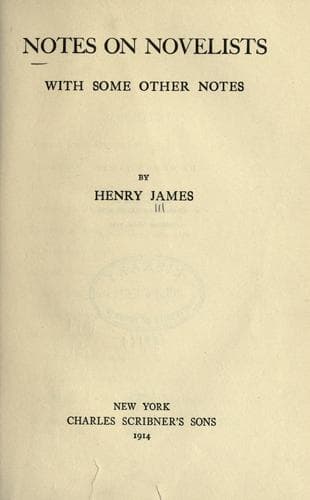
Notes on Novelists, with Some Other NotesJames, Henry
History
Notes on Novelists, with Some Other Notes
James, Henry
Fiction -- History and criticism; Novelists
truly a monument to Zola’s patience; the subject being so ungrateful, so
formidably special, that the multiplication of illustrative detail, the
plunge into pestilent depths, represents a kind of technical
intrepidity.
There are other plunges, into different sorts of darkness; of which the
esthetic, even the scientific, even the ironic motive fairly escapes
us—explorations of stagnant pools like that of “La Joie de Vivre,” as
to which, granting the nature of the curiosity and the substance
laboured in, the patience is again prodigious, but which make us wonder
what pearl of philosophy, of suggestion or just of homely recognition,
the general picture, as of rats dying in a hole, has to offer. Our
various senses, sight, smell, sound, touch, are, as with Zola always,
more or less convinced; but when the particular effect upon each of
these is added to the effect upon the others the mind still remains
bewilderedly unconscious of any use for the total. I am not sure indeed
that the case is in this respect better with the productions of the
third order—“La Faute de l’Abbé Mouret,” “Une Page d’Amour,” “Le Rêve,”
“Le Docteur Pascal”—in which the appeal is more directly, is in fact
quite earnestly, to the moral vision; so much, on such ground, was to
depend precisely on those discriminations in which the writer is least
at home. The volumes whose names I have just quoted are his express
tribute to the “ideal,” to the select and the charming—fair fruits of
invention intended to remove from the mouth so far as possible the
bitterness of the ugly things in which so much of the rest of his work
had been condemned to consist. The subjects in question then are
“idyllic” and the treatment poetic, concerned essentially to please on
the largest lines and involving at every turn that salutary need. They
are matters of conscious delicacy, and nothing might interest us more
than to see what, in the shock of the potent forces enlisted, becomes of
this shy element. Nothing might interest us more, literally, and might
positively affect us more, even very nearly to tears, though indeed
sometimes also to smiles, than to see the constructor of Les
Rougon-Macquart trying, “for all he is worth,” to be fine with fineness,
finely tender, finely true—trying to be, as it is called,
distinguished—in face of constitutional hindrance.
Public-domain text, read in full here on John Shaqi.
Reviews
Reviews
No reviews yet
Be the first to share your thoughts on this work.
Join the Discussion
Join the discussion
Sign in to leave a comment or review.
Sign InorCreate an account