Notes on Novelists, with Some Other Notes — John Shaqi
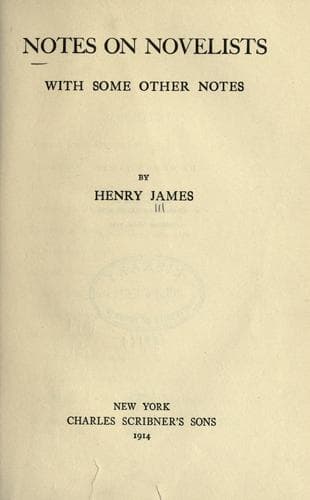
Notes on Novelists, with Some Other NotesJames, Henry
History
Notes on Novelists, with Some Other Notes
James, Henry
Fiction -- History and criticism; Novelists
That is very well, and the value, in a hundred ways, of a mass of
production conceived in such a spirit can never (when robust execution
has followed) be small. But the formula really sees us no further. It
offers a definition which is no definition. “Science” is soon said—the
whole thing depends on the ground so covered. Science accepts surely
_all_ our consciousness of life; even, rather, the latter closes
maternally round it—so that, becoming thus a force within us, not a
force outside, it exists, it illuminates only as we apply it. We do
emphatically apply it in art. But Zola would apparently hold that it
much more applies _us_. On the showing of many of his volumes then it
makes but a dim use of us, and this we should still consider the case
even were we sure that the article offered us in the majestic name is
absolutely at one with its own pretension. This confidence we can on too
many grounds never have. The matter is one of appreciation, and when an
artist answers for science who answers for the artist—who at the least
answers for art? Thus it is with the mistakes that affect us, I say, as
Zola’s penalties. We are reminded by them that the game of art has, as
the phrase is, to be played. It may not with any sure felicity for the
result be both taken and left. If you insist on the common you must
submit to the common; if you discriminate, on the contrary, you must,
however invidious your discriminations may be called, trust to them to
see you through.
To the common then Zola, often with splendid results, inordinately
sacrifices, and this fact of its overwhelming him is what I have called
his paying for it. In “L’Assommoir,” in “Germinal,” in “La Débâcle,”
productions in which he must most survive, the sacrifice is ordered and
fruitful, for the subject and the treatment harmonise and work together.
He describes what he best feels, and feels it more and more as it
naturally comes to him—quite, if I may allow myself the image, as we
zoologically see some mighty animal, a beast of a corrugated hide and a
portentous snout, soaking with joy in the warm ooze of an African
riverside. In these cases everything matches, and “science,” we may be
permitted to believe, has had little hand in the business. The author’s
perceptions go straight, and the subject, grateful and responsive, gives
itself wholly up. It is no longer a case of an uncertain smoky torch,
but of a personal vision, the vision of genius, springing from an inward
source. Of this genius “L’Assommoir” is the most extraordinary record.
It contains, with the two companions I have given it, all the best of
Zola, and the three books together are solid ground—or would be could I
now so take them—for a study of the particulars of his power. His
strongest marks and features abound in them; “L’Assommoir” above all is
(not least in respect to its bold free linguistic reach, already glanced
at) completely genial, while his misadventures, his unequipped and
Public-domain text, read in full here on John Shaqi.
Reviews
Reviews
No reviews yet
Be the first to share your thoughts on this work.
Join the Discussion
Join the discussion
Sign in to leave a comment or review.
Sign InorCreate an account