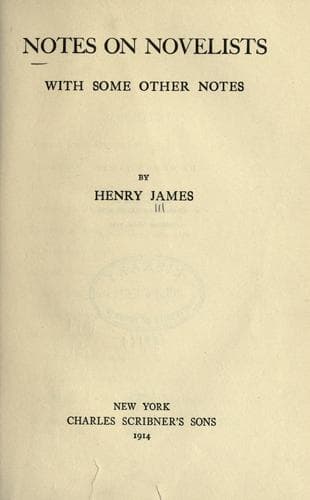
Notes on Novelists, with Some Other NotesJames, Henry
History
Notes on Novelists, with Some Other Notes
James, Henry
Fiction -- History and criticism; Novelists
The central event of his life was his journey to the East in 1849 with
M. Maxime Du Camp, of which the latter has left in his “Impressions
Littéraires” a singularly interesting and, as we may perhaps say,
slightly treacherous report, and which prepared for Flaubert a state of
nostalgia that was not only never to leave him, but that was to work in
him as a motive. He had during that year, and just in sufficient
quantity, his revelation, the particular appropriate disclosure to which
the gods at some moment treat the artist unless they happen too
perversely to conspire against him: he tasted of the knowledge by which
he was subsequently to measure everything, appeal from everything, find
everything flat. Never probably was an impression so assimilated, so
positively transmuted to a function; he lived on it to the end and we
may say that in “Salammbô” and “La Tentation de Saint-Antoine” he almost
died of it. He made afterwards no other journey of the least importance
save a disgusted excursion to the Rigi-Kaltbad shortly before his death.
The Franco-German War was of course to him for the time as the valley of
the shadow itself; but this was an ordeal, unlike most of his other
ordeals, shared after all with millions. He never married—he declared,
toward the end, to the most comprehending of his confidants, that he had
been from the first “afraid of life”; and the friendliest element of his
later time was, we judge, that admirable comfortable commerce, in her
fullest maturity, with Madame George Sand, the confidant I just referred
to; which has been preserved for us in the published correspondence of
each. He had in Ivan Turgenieff a friend almost as valued; he spent each
year a few months in Paris, where (to mention everything) he had his
natural place, so far as he cared to take it, at the small literary
court of the Princess Mathilde; and, lastly, he lost toward the close of
his life, by no fault of his own, a considerable part of his modest
fortune. It is, however, in the long security, the almost unbroken
solitude of Croisset, near Rouen, that he mainly figures for us, gouging
out his successive books in the wide old room, of many windows, that,
with an intervening terrace, overlooked the broad Seine and the passing
boats. This was virtually a monastic cell, closed to echoes and
accidents; with its stillness for long periods scarce broken save by the
creak of the towing-chain of the tugs across the water. When I have
added that his published letters offer a view, not very refreshing, of
his youthful entanglement with Madame Louise Colet—whom we name
because, apparently not a shrinking person, she long ago practically
named herself—I shall have catalogued his personal vicissitudes. And I
may add further that the connection with Madame Colet, such as it was,
rears its head for us in something like a desert of immunity from such
complications.
Public-domain text, read in full here on John Shaqi.
Reviews
Reviews
No reviews yet
Be the first to share your thoughts on this work.
Join the Discussion
Join the discussion
Sign in to leave a comment or review.
Sign InorCreate an account