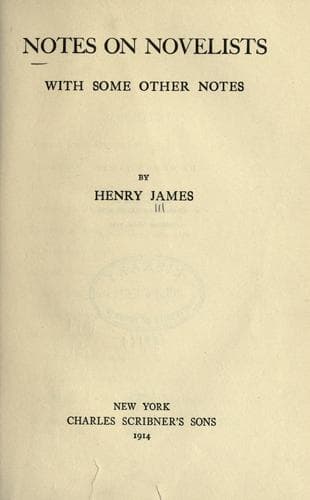
Notes on Novelists, with Some Other NotesJames, Henry
History
Notes on Novelists, with Some Other Notes
James, Henry
Fiction -- History and criticism; Novelists
Frédéric Moreau on the threshold of life and conducts him to the extreme
of maturity without apparently suspecting for a moment either our wonder
or our protest—“Why, why him?” Frédéric is positively too poor for his
part, too scant for his charge; and we feel with a kind of
embarrassment, certainly with a kind of compassion, that it is somehow
the business of a protagonist to prevent in his designer an excessive
waste of faith. When I speak of the faith in Emma Bovary as
proportionately wasted I reflect on M. Faguet’s judgment that she is
from the point of view of deep interest richly or at least roundedly
representative. Representative of what? he makes us ask even while
granting all the grounds of misery and tragedy involved. The plea for
her is the plea made for all the figures that live without evaporation
under the painter’s hand—that they are not only particular persons but
types of their kind, and as valid in one light as in the other. It is
Emma’s “kind” that I question for this responsibility, even if it be
inquired of me why I then fail to question that of Charles Bovary, in
its perfection, or that of the inimitable, the immortal Homais. If we
express Emma’s deficiency as the poverty of her consciousness for the
typical function, it is certainly not, one must admit, that she is
surpassed in this respect either by her platitudinous husband or by his
friend the pretentious apothecary. The difference is none the less
somehow in the fact that they are respectively studies but of their
character and office, which function in each expresses adequately _all_
they are. It may be, I concede, because Emma is the only woman in the
book that she is taken by M. Faguet as _femininely_ typical, typical in
the larger illustrative way, whereas the others pass with him for images
specifically conditioned. Emma is this same for myself, I plead; she is
conditioned to such an excess of the specific, and the specific in her
case leaves out so many even of the commoner elements of conceivable
life in a woman when we are invited to see that life as pathetic, as
dramatic agitation, that we challenge both the author’s and the critic’s
scale of importances. The book is a picture of the middling as much as
they like, but does Emma attain even to _that_? Hers is a narrow
middling even for a little imaginative person whose “social”
significance is small. It is greater on the whole than her capacity of
consciousness, taking this all round; and so, in a word, we feel her
less illustrational than she might have been not only if the world had
offered her more points of contact, but if she had had more of these to
give it.
Public-domain text, read in full here on John Shaqi.
Reviews
Reviews
No reviews yet
Be the first to share your thoughts on this work.
Elsewhere in the archive
Join the Discussion
Join the discussion
Sign in to leave a comment or review.
Sign InorCreate an account