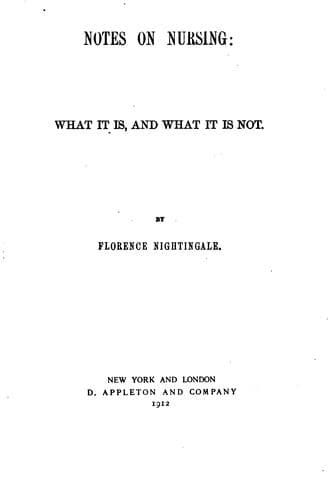
Notes on Nursing: What It Is, and What It Is NotNightingale, Florence
Science
Notes on Nursing: What It Is, and What It Is Not
Nightingale, Florence
Nursing
It is often said that, in regimental hospitals, patients ought to "nurse
each other," because the number of sick altogether being, say, but
thirty, and out of these one only perhaps being seriously ill, and the
other twenty-nine having little the matter with them, and nothing to do,
they should be set to nurse the one; also, that soldiers are so
trained to obey, that they will be the most obedient, and therefore the
best of nurses, add to which they are always kind to their comrades.
Now, have those who say this, considered that, in order to obey, you
must know _how_ to obey, and that these soldiers certainly do not know
how to obey in nursing. I have seen these "kind" fellows (and how kind
they are no one knows so well as myself) move a comrade so that, in one
case at least, the man died in the act. I have seen the comrades'
"kindness" produce abundance of spirits, to be drunk in secret. Let no
one understand by this that female nurses ought to, or could be
introduced in regimental hospitals. It would be most undesirable, even
were it not impossible. But the head nurseship of a hospital serjeant is
the more essential, the more important, the more inexperienced the
nurses. Undoubtedly, a London hospital "sister" does sometimes set
relays of patients to watch a critical case; but, undoubtedly also,
always under her own superintendence; and she is called to whenever
there is something to be done, and she knows how to do it. The patients
are not left to do it of their own unassisted genius, however "kind" and
willing they may be.
IV. NOISE.
[Sidenote: Unnecessary noise.]
Unnecessary noise, or noise that creates an expectation in the mind, is
that which hurts a patient. It is rarely the loudness of the noise, the
effect upon the organ of the ear itself, which appears to affect the
sick. How well a patient will generally bear, _e. g._, the putting up of
a scaffolding close to the house, when he cannot bear the talking, still
less the whispering, especially if it be of a familiar voice, outside
his door.
There are certain patients, no doubt, especially where there is slight
concussion or other disturbance of the brain, who are affected by mere
noise. But intermittent noise, or sudden and sharp noise, in these as in
all other cases, affects far more than continuous noise--noise with jar
far more than noise without. Of one thing you may be certain, that
anything which wakes a patient suddenly out of his sleep will invariably
put him into a state of greater excitement, do him more serious, aye,
and lasting mischief, than any continuous noise, however loud.
[Sidenote: Never let a patient be waked out of his first sleep.]
Public-domain text, read in full here on John Shaqi.
Reviews
Reviews
No reviews yet
Be the first to share your thoughts on this work.
Join the Discussion
Join the discussion
Sign in to leave a comment or review.
Sign InorCreate an account