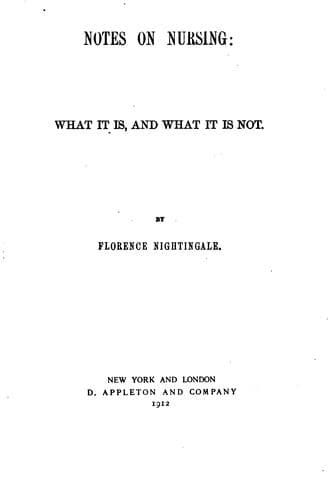
Notes on Nursing: What It Is, and What It Is Not — John Shaqi
Notes on Nursing: What It Is, and What It Is NotNightingale, Florence
Science
Notes on Nursing: What It Is, and What It Is Not
Nightingale, Florence
Nursing
[Sidenote: Never read aloud by fits and starts to the sick.]
(2.) The extraordinary habit of reading to oneself in a sick room, and
reading aloud to the patient any bits which will amuse him or more often
the reader, is unaccountably thoughtless. What _do_ you think the
patient is thinking of during your gaps of non-reading? Do you think
that he amuses himself upon what you have read for precisely the time it
pleases you to go on reading to yourself, and that his attention is
ready for something else at precisely the time it pleases you to begin
reading again? Whether the person thus read to be sick or well, whether
he be doing nothing or doing something else while being thus read to,
the self-absorption and want of observation of the person who does it,
is equally difficult to understand--although very often the read_ee_ is
too amiable to say how much it hurts him.
[Sidenote: People overhead.]
One thing more:--From, the flimsy manner in which most modern houses are
built, where every step on the stairs, and along the floors, is felt all
over the house; the higher the story, the greater the vibration. It is
inconceivable how much the sick suffer by having anybody overhead. In
the solidly built old houses, which, fortunately, most hospitals are,
the noise and shaking is comparatively trifling. But it is a serious
cause of suffering, in lightly built houses, and with the irritability
peculiar to some diseases. Better far put such patients at the top of
the house, even with the additional fatigue of stairs, if you cannot
secure the room above them being untenanted; you may otherwise bring on
a state of restlessness which no opium will subdue. Do not neglect the
warning, when a patient tells you that he "Feels every step above him to
cross his heart." Remember that every noise a patient cannot _see_
partakes of the character of suddenness to him; and I am persuaded that
patients with these peculiarly irritable nerves, are positively less
injured by having persons in the same room with them than overhead, or
separated by only a thin compartment. Any sacrifice to secure silence
for these cases is worth while, because no air, however good, no
attendance, however careful, will do anything for such cases without
quiet.
[Sidenote: Music.]
NOTE.--The effect of music upon the sick has been scarcely at all
noticed. In fact, its expensiveness, as it is now, makes any general
application of it quite out of the question. I will only remark here,
that wind instruments, including the human voice, and stringed
instruments, capable of continuous sound, have generally a beneficent
effect--while the piano-forte, with such instruments as have _no_
continuity of sound, has just the reverse. The finest piano-forte
playing will damage the sick, while an air, like "Home, sweet home," or
"Assisa a piè d'un salice," on the most ordinary grinding organ, will
sensibly soothe them--and this quite independent of association.
FOOTNOTES:
Public-domain text, read in full here on John Shaqi.
Reviews
Reviews
No reviews yet
Be the first to share your thoughts on this work.
Join the Discussion
Join the discussion
Sign in to leave a comment or review.
Sign InorCreate an account