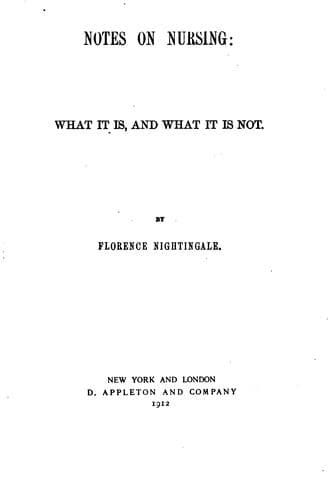
Notes on Nursing: What It Is, and What It Is NotNightingale, Florence
Science
Notes on Nursing: What It Is, and What It Is Not
Nightingale, Florence
Nursing
The following causes of "accidental" death in sick children are
enumerated:--"Sudden noises, which startle--a rapid change of
temperature, which chills the surface, though only for a moment--a rude
awakening from sleep--or even an over-hasty, or an overfull meal"--"any
sudden impression on the nervous system--any hasty alteration of
posture--in short, any cause whatever by which the respiratory process
may be disturbed."
It may again be added, that, with very weak adult patients, these causes
are also (not often "suddenly fatal," it is true, but) very much oftener
than is at all generally known, irreparable in their consequences.
Both for children and for adults, both for sick and for well (although
more certainly in the case of sick children than in any others), I would
here again repeat, the most frequent and most fatal cause of all is
sleeping, for even a few hours, much more for weeks and months, in foul
air, a condition which, more than any other condition, disturbs the
respiratory process, and tends to produce "accidental" death in disease.
I need hardly here repeat the warning against any confusion of ideas
between cold and fresh air. You may chill a patient fatally without
giving him fresh air at all. And you can quite well, nay, much better,
give him fresh air without chilling him. This is the test of a good
nurse.
In cases of long recurring faintnesses from disease, for instance,
especially disease which affects the organs of breathing, fresh air to
the lungs, warmth to the surface, and often (as soon as the patient can
swallow) hot drink, these are the right remedies and the only ones.
Yet, oftener than not, you see the nurse or mother just reversing this;
shutting up every cranny through which fresh air can enter, and leaving
the body cold, or perhaps throwing a greater weight of clothes upon it,
when already it is generating too little heat.
"Breathing carefully, anxiously, as though respiration were a function
which required all the attention for its performance," is cited as a not
unusual state in children, and as one calling for care in all the things
enumerated above. That breathing becomes an almost voluntary act, even
in grown up patients who are very weak, must often have been remarked.
"Disease having interfered with the perfect accomplishment of the
respiratory function, some sudden demand for its complete exercise,
issues in the sudden standstill of the whole machinery," is given as one
process:--"life goes out for want of nervous power to keep the vital
functions in activity," is given as another, by which "accidental" death
is most often brought to pass in infancy.
Also in middle age, both these processes may be seen ending in death,
although generally not suddenly. And I have seen, even in middle age,
the "_sudden_ stand-still" here mentioned, and from the same causes.
[Sidenote: Summary.]
Public-domain text, read in full here on John Shaqi.
Reviews
Reviews
No reviews yet
Be the first to share your thoughts on this work.
Elsewhere in the archive
Join the Discussion
Join the discussion
Sign in to leave a comment or review.
Sign InorCreate an account