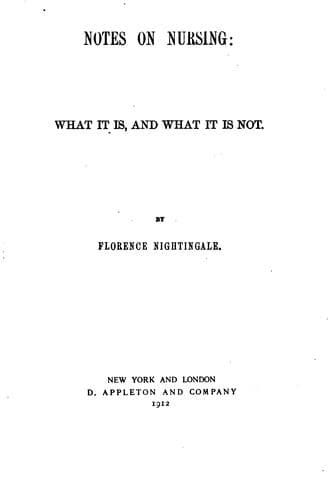
Notes on Nursing: What It Is, and What It Is NotNightingale, Florence
Science
Notes on Nursing: What It Is, and What It Is Not
Nightingale, Florence
Nursing
To sum up:--the answer to two of the commonest objections urged, one by
women themselves, the other by men, against the desirableness of
sanitary knowledge for women, _plus_ a caution, comprises the whole
argument for the art of nursing.
[Sidenote: Reckless amateur physicking by women. Real knowledge of the
laws of health alone can check this.]
(1.) It is often said by men, that it is unwise to teach women anything
about these laws of health, because they will take to physicking,--that
there is a great deal too much of amateur physicking as it is, which is
indeed true. One eminent physician told me that he had known more
calomel given, both at a pinch and for a continuance, by mothers,
governesses, and nurses, to children than he had ever heard of a
physician prescribing in all his experience. Another says, that women's
only idea in medicine is calomel and aperients. This is undeniably too
often the case. There is nothing ever seen in any professional practice
like the reckless physicking by amateur females.[1] But this is just
what the really experienced and observing nurse does _not_ do; she
neither physics herself nor others. And to cultivate in things
pertaining to health observation and experience in women who are
mothers, governesses or nurses, is just the way to do away with amateur
physicking, and if the doctors did but know it, to make the nurses
obedient to them,--helps to them instead of hindrances. Such education
in women would indeed diminish the doctor's work--but no one really
believes that doctors wish that there should be more illness, in order
to have more work.
[Sidenote: What pathology teaches. What observation alone teaches. What
medicine does. What nature alone does.]
(2.) It is often said by women, that they cannot know anything of the
laws of health, or what to do to preserve their children's health,
because they can know nothing of "Pathology," or cannot "dissect,"--a
confusion of ideas which it is hard to attempt to disentangle.
Public-domain text, read in full here on John Shaqi.
Reviews
Reviews
No reviews yet
Be the first to share your thoughts on this work.
Elsewhere in the archive
Join the Discussion
Join the discussion
Sign in to leave a comment or review.
Sign InorCreate an account