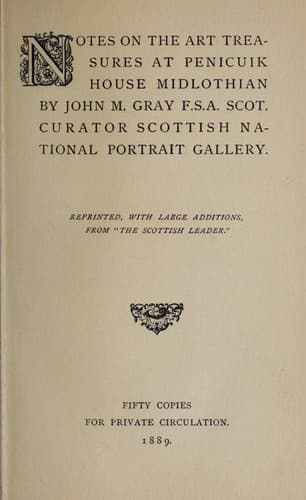
Notes on the Art Treasures at Penicuik House MidlothianGray, John Miller
Philosophy
Notes on the Art Treasures at Penicuik House Midlothian
Gray, John Miller
Art -- Scotland -- Penicuik; Penicuik House (Penicuik, Scotland)
“By your assistance unconstrain’d,
To courts I can repair,
And by your art my way I’ve gained
To closets of the fair.”
There are many other portraits which enable us to gather what was the
personal appearance of the author of “The Gentle Shepherd.” There is
the print in which the poet appears in all the bright bravery of youth,
clad in a kind of fanciful Scottish costume,—a coat slashed at the
sleeves, a plaid laid over his right shoulder, a broad Highland bonnet,
with a St. Andrew badge, set on the head. This is the frontispiece to
the first quarto edition of his works, published by Ruddiman in 1721:
it is engraved by T. Vereruysse, and bears the initials J. S. P.,
which, as we learn from the engraving by Vertue, evidently from the
same picture, in Ramsay’s “Poems and Songs,” 1728, stands for “John
Smibert, Pinxit.” This painter, born in Edinburgh in 1684, was a friend
and correspondent of Ramsay’s, and it was to him, while studying art in
Italy, that the poet addressed that “Epistle to a Friend in Florence”
which is included in his works. He accompanied Bishop Berkeley to Rhode
Island in 1727, and afterwards settled in Boston, where he resided till
his death in 1751. In Britain his works are scarce, but a portrait of
Berkeley by his hand is in the National Portrait Gallery, London, and
there is at Monymusk, Aberdeenshire, along with minor examples of his
art, an important group of Lord Cullen and his family, including twelve
life-sized figures, which he painted in 1720. Smibert is believed to
have executed a second portrait of Allan Ramsay, that kit-cat likeness
with the head turned nearly in profile to the left, which formed
the frontispiece to “The Gentle Shepherd, with Illustrations of the
Scenery,” Edinburgh 1814, engraved by A. Wilson, from a drawing made
by A. Carse from the picture (now at New Hall, Mid-Lothian), which
had belonged to the poet himself, and afterwards to Janet Ramsay, a
daughter who survived him.
Again there is a singularly heavy-looking and spiritless portrait
engraved in the second volume of Ruddiman’s 1728 edition of Ramsay’s
works, marked as by Strange’s master, “R. Cooper, ad vivum sculpsit,
Edin^r,” showing the figure to the waist, the right hand holding a
volume of the Poems; and the smaller print, without name of painter or
engraver, which seems to be an improved adaptation of this portrait,
the face become refined and delicate, a fitting face for a poet.
Public-domain text, read in full here on John Shaqi.
Reviews
Reviews
No reviews yet
Be the first to share your thoughts on this work.
Join the Discussion
Join the discussion
Sign in to leave a comment or review.
Sign InorCreate an account