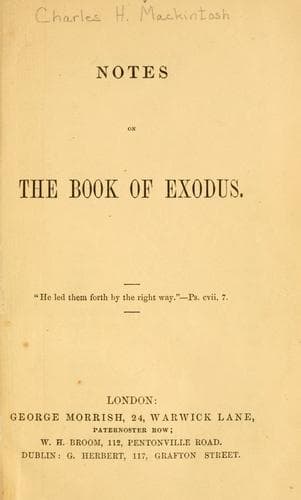
Notes on the book of ExodusMackintosh, Charles Henry
Religion
Notes on the book of Exodus
Mackintosh, Charles Henry
Bible. Exodus -- Commentaries
True Christianity is but the manifestation of the life of Christ,
implanted in us by the operation of the Holy Ghost, in pursuance of
God's eternal counsels of sovereign grace; and all our doings previous
to the implantation of this life are but "dead works," from which we
need to have our consciences purged just as much as from "wicked
works." (Heb. ix. 14.) The term "dead works" comprehends all works
which men do with the direct object of getting life. If a man is
seeking for life, it is very evident that he has not yet gotten it. He
may be very sincere in seeking it, but his very sincerity only makes
it the more obvious that, as yet, he has not consciously reached it.
Hence, therefore, everything done in order to get life is a dead work,
inasmuch as it is done without life--the life of Christ, the only true
life, the only source from whence good works can flow. And, observe,
it is not a question of "wicked works;" no one would think of getting
life by such. No; you will find, on the contrary, that persons
continually have recourse to "dead works," in order to ease their
consciences, under the sense of "wicked works," whereas divine
revelation teaches us that the conscience needs to be purged from the
one as well as the other.
Again, as to righteousness, we read that "all our righteousnesses are
as filthy rags." It is not said that all our wickednesses, merely, are
as filthy rags. This would at once be admitted. But the fact is, that
the very best fruit which we can produce, in the shape of
religiousness and righteousness, is represented, on the page of
eternal truth, as "dead works," and "filthy rags." Our very efforts
after life do but prove us to be dead, and our very efforts after
righteousness do but prove us to be enwrapped in filthy rags. It is
only as the actual possessors of eternal life and divine righteousness
that we can walk in the divinely prepared path of good works. Dead
works and filthy rags could never be suffered to appear in such a
path. None but "the redeemed of the Lord" can walk therein. It was as
a redeemed people that Israel kept the feast of unleavened bread, and
dedicated their first-born to Jehovah. The former of these observances
we have already considered; as to the latter, it contains a rich mine
of instruction.
Public-domain text, read in full here on John Shaqi.
Reviews
Reviews
No reviews yet
Be the first to share your thoughts on this work.
Elsewhere in the archive
Join the Discussion
Join the discussion
Sign in to leave a comment or review.
Sign InorCreate an account