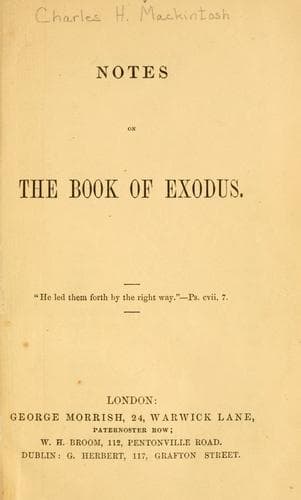
Notes on the book of ExodusMackintosh, Charles Henry
Religion
Notes on the book of Exodus
Mackintosh, Charles Henry
Bible. Exodus -- Commentaries
The destroying angel passed through the land of Egypt to destroy all
the first-born; but Israel's first-born escaped through the death of a
divinely provided substitute. Accordingly, these latter appear before
us, in this chapter, as a living people, dedicated to God. Saved by
the blood of the lamb, they are privileged to consecrate their
ransomed life to Him who had ransomed it. Thus it was only as redeemed
that they possessed life. The grace of God alone had made them to
differ, and had given them the place of living men in His presence. In
their case, assuredly, there was no room for boasting; for, as to any
personal merit or worthiness, we learn from this chapter that they
were put on a level with an unclean and worthless thing.--"Every
firstling of an ass thou shalt redeem with a lamb; and if thou wilt
not redeem it, then thou shalt break his neck; and all the first-born
of man among thy children shalt thou redeem." (Ver. 13.) There were
two classes--the clean and the unclean, and man was classed with the
latter. The lamb was to answer for the unclean; and if the ass were
not redeemed, his neck was to be broken; so that an unredeemed man was
put upon a level with an unclean animal, and that, moreover, in a
condition than which nothing could be more worthless and unsightly.
What a humiliating picture of man in his natural condition! O, that
our poor proud hearts could enter more into it! Then should we rejoice
more unfeignedly in the happy privilege of being washed from our guilt
in the blood of the Lamb, and having all our personal vileness left
behind forever, in the tomb where our Surety lay buried.
Christ was the Lamb--the clean, the spotless Lamb: we were unclean;
but (forever adored be His matchless name!) He took our position, and,
_on the cross_, was made sin, and treated as such. That which we
should have endured throughout the countless ages of eternity, He
endured for us on the tree. He bore _all_ that was due to us, there
and then, in order that we might enjoy what is due to Him, forever. He
got our desserts that we might get His. The clean took, for a time,
the place of the unclean, in order that the unclean might take forever
the place of the clean. Thus, whereas by nature we are represented by
the loathsome figure of an ass with his neck broken, by grace we are
represented by a risen and glorified Christ in heaven. Amazing
contrast! It lays man's glory in the dust, and magnifies the riches of
redeeming love. It silences man's empty boastings, and puts into his
mouth a hymn of praise to God and the Lamb, which shall swell
throughout the courts of heaven during the everlasting ages.[7]
Public-domain text, read in full here on John Shaqi.
Reviews
Reviews
No reviews yet
Be the first to share your thoughts on this work.
Elsewhere in the archive
Join the Discussion
Join the discussion
Sign in to leave a comment or review.
Sign InorCreate an account