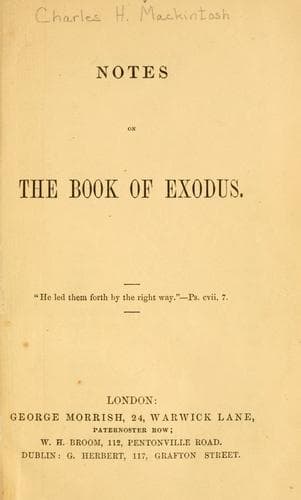
Notes on the book of ExodusMackintosh, Charles Henry
Religion
Notes on the book of Exodus
Mackintosh, Charles Henry
Bible. Exodus -- Commentaries
So it was with Israel in their very first moment of trial. They really
thought that the Lord had taken such pains to deliver them out of
Egypt merely to let them die in the wilderness. They imagined that
they had been preserved by the blood of the paschal lamb in order that
they might be buried in the wilderness. Thus it is that unbelief ever
reasons. It leads us to interpret God in the presence of the
difficulty, instead of interpreting the difficulty in the presence of
God. Faith gets behind the difficulty and there finds God, in all His
faithfulness, love, and power. It is the believer's privilege ever to
be in the presence of God. He has been introduced thither by the blood
of the Lord Jesus Christ, and nothing should be suffered to take him
thence. The place itself he never can lose, inasmuch as his Head and
Representative, Christ, occupies it on his behalf. But although he
cannot lose the thing itself, he can very easily lose the enjoyment of
it--the experience and power of it. Whenever his difficulties come
between his heart and the Lord, he is evidently not enjoying the
Lord's presence, but suffering in the presence of his difficulties.
Just as when a cloud comes between us and the sun, it robs us, for the
time, of the enjoyment of his beams. It does not prevent him from
shining, it merely hinders our enjoyment of him. Exactly so is it when
we allow trials and sorrows, difficulties and perplexities, to hide
from our souls the bright beams of our Father's countenance, which
ever shine, with changeless lustre, in the face of Jesus Christ. There
is no difficulty too great for our God; yea, the greater the
difficulty, the more room there is for Him to act in His proper
character, as the God of all power and grace. No doubt Israel's
position, in the opening of our chapter, was a deeply trying one,--to
flesh and blood, perfectly overwhelming; but then the Maker of heaven
and earth was there, and they had but to use Him.
Yet, alas! my reader, how speedily we fail when trial arises! These
sentiments sound very nicely on the ear, and look very well upon paper
(and, blessed be God, they are divinely true); but then the thing is
to practice them when opportunity offers. It is in the practice of
them that their power and blessedness are really proved. "If any man
will _do_ His will, he shall _know_ of the doctrine, whether it be of
God." (John vii. 17.)
Public-domain text, read in full here on John Shaqi.
Reviews
Reviews
No reviews yet
Be the first to share your thoughts on this work.
Elsewhere in the archive
Join the Discussion
Join the discussion
Sign in to leave a comment or review.
Sign InorCreate an account