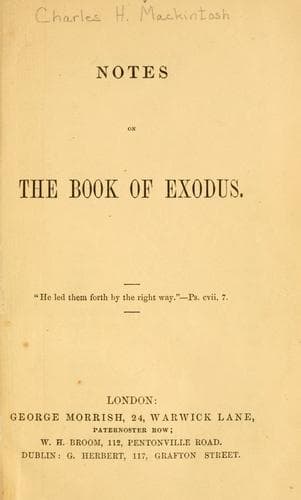
Notes on the book of ExodusMackintosh, Charles Henry
Religion
Notes on the book of Exodus
Mackintosh, Charles Henry
Bible. Exodus -- Commentaries
"And Moses said unto the people, 'Fear ye not, stand still, and see
the salvation of the Lord, which He will show to you to-day; for the
Egyptians whom ye have seen to-day ye shall see them again no more
forever. The Lord shall fight for you, and ye shall hold your peace.'"
(Ver. 13, 14.) Here is the first attitude which faith takes in the
presence of a trial. "_Stand still._" This is impossible to flesh and
blood. All who know, in any measure, the restlessness of the human
heart under anticipated trial and difficulty, will be able to form
some conception of what is involved in standing still. Nature must be
_doing_ something. It will rush hither and thither. It would fain have
some hand in the matter. And although it may attempt to justify and
sanctify its worthless doings, by bestowing upon them the imposing and
popular title of "a legitimate use of means," yet are they the plain
and positive fruits of unbelief, which always shuts out God, and sees
naught save the dark cloud of its own creation. Unbelief creates or
magnifies difficulties, and then sets us about removing them by our
own bustling and fruitless activities, which, in reality, do but raise
a dust around us which prevents our seeing God's salvation.
Faith, on the contrary, raises the soul above the difficulty, straight
to God Himself, and enables one to "stand still." We gain nothing by
our restless and anxious efforts. "We cannot make one hair white or
black," nor "add one cubit to our stature." What could Israel do at
the Red Sea? Could they dry it up? Could they level the mountains?
Could they annihilate the hosts of Egypt? Impossible! There they were,
inclosed within an impenetrable wall of difficulties, in view of which
nature could but tremble and feel its own perfect impotency. But this
was just the time for God to act. When unbelief is driven from the
scene, then God can enter; and, in order to get a proper view of His
actings, we must "stand still." Every movement of nature is, so far as
it goes, a positive hindrance to our perception and enjoyment of
divine interference on our behalf.
This is true of us in every single stage of our history. It is true of
us as sinners when, under the uneasy sense of sin upon the conscience,
we are tempted to resort to our own doings in order to obtain relief.
Then, truly, we must "stand still" in order to "see the salvation of
God." For what could we do in the matter of making an atonement for
sin? Could we have stood with the Son of God upon the cross? Could we
have accompanied Him down into the "horrible pit and the miry clay"?
Could we have forced our passage upward to that eternal rock on which,
in resurrection, He has taken His stand? Every right mind will at once
pronounce the thought to be a daring blasphemy. God is alone in
redemption; and as for us, we have but to "stand still, and see the
salvation of God." The very fact of its being God's salvation proves
that man has naught to do in it.
Public-domain text, read in full here on John Shaqi.
Reviews
Reviews
No reviews yet
Be the first to share your thoughts on this work.
Elsewhere in the archive
Join the Discussion
Join the discussion
Sign in to leave a comment or review.
Sign InorCreate an account