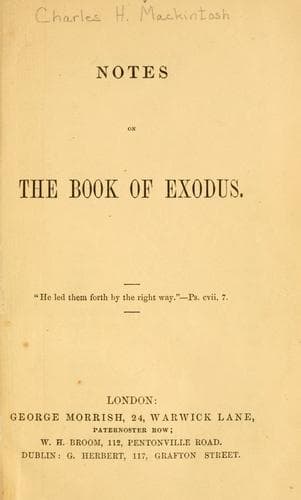
Notes on the book of ExodusMackintosh, Charles Henry
Religion
Notes on the book of Exodus
Mackintosh, Charles Henry
Bible. Exodus -- Commentaries
There are three distinct positions in which we may contemplate Israel,
namely, in Egypt, in the wilderness, and in the land of Canaan. In all
these, they are "our types;" but we are in all three together. This
may seem paradoxical, but it is true. As a matter of actual fact, we
are in Egypt, surrounded by natural things, which are entirely adapted
to the natural heart. But, inasmuch as we have been called by God's
grace into fellowship with His Son Jesus Christ, we, according to the
affections and desires of the new nature, necessarily find our place
outside of all that which belongs to Egypt[8] (_i.e._, the world in
its natural state), and this causes us to taste of wilderness
experience, or, in other words, it places us, as a matter of
experience, in the wilderness. The divine nature earnestly breathes
after a different order of things--after a purer atmosphere than that
with which we find ourselves surrounded, and thus it causes us to feel
Egypt to be a moral desert.
[8] There is a wide moral difference between Egypt and Babylon, which
it is important to understand. Egypt was that out of which Israel
came; Babylon was that into which they were afterwards carried. (Comp.
Amos v. 25-27 with Acts vii. 42, 43.) Egypt expresses what man has
made of the world; Babylon expresses what Satan has made, is making,
or will make, of the professing church. Hence, we are not only
surrounded with the _circumstances_ of Egypt, but also by the moral
_principles_ of Babylon.
This renders our "days" what the Holy Ghost has termed "perilous"
(χαλεποι--"difficult"). It demands a special energy of the Spirit of
God, and complete subjection to the authority of the Word, to enable
one to meet the combined influence of the realities of Egypt and the
spirit and principles of Babylon. The former meet the natural desires
of the heart; while the latter connect themselves with, and address
themselves to, the _religiousness_ of nature, which gives them a
peculiar hold upon the heart. Man is a religious being, and peculiarly
susceptible of the influences which arise from music, sculpture,
painting, and pompous rites and ceremonies. When these things stand
connected with the full supply of all his natural wants--yea, with all
the ease and luxury of life, nothing but the mighty power of God's
Word and Spirit can keep one true to Christ.
Public-domain text, read in full here on John Shaqi.
Reviews
Reviews
No reviews yet
Be the first to share your thoughts on this work.
Elsewhere in the archive
Join the Discussion
Join the discussion
Sign in to leave a comment or review.
Sign InorCreate an account