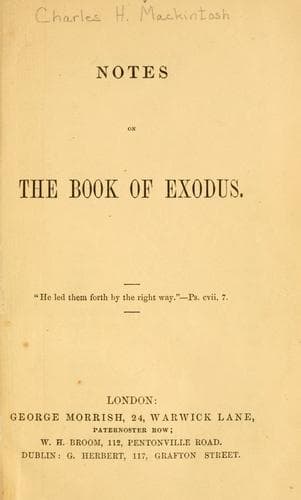
Notes on the book of ExodusMackintosh, Charles Henry
Religion
Notes on the book of Exodus
Mackintosh, Charles Henry
Bible. Exodus -- Commentaries
We should also remark that there is a vast difference between the
destinies of Egypt and those of Babylon. The nineteenth of Isaiah sets
before us the blessings that are in store for Egypt. It concludes
thus: "And the Lord shall smite Egypt; He shall smite and heal it; and
they shall return even to the Lord, and He shall be entreated of them,
and shall heal them.... In that day shall Israel be the third with
Egypt and with Assyria, even a blessing in the midst of the land; whom
the Lord of Hosts shall bless, saying, Blessed be Egypt My people, and
Assyria the work of My hands, and Israel Mine inheritance." (Ver.
22-25.)
Very different is the close of Babylon's history, whether viewed as a
literal city or a spiritual system.--"I will also make it a possession
for the bittern, and pools of water; and I will sweep it with the
besom of destruction, saith the Lord of Hosts." (Isaiah xiv. 23.) "It
shall never be inhabited, neither shall it be dwelt in from generation
to generation." (Isaiah xiii. 20.) So much for Babylon literally; and
looking at it from a mystic or spiritual point of view, we read its
destiny in Rev. xviii. The entire chapter is a description of Babylon,
and it concludes thus: "A strong angel took up a stone, like a great
millstone, and cast it into the sea, saying, 'Thus, with violence
shall that great city Babylon be thrown down, and shall be found no
more at all.'" (Ver. 21.)
With what immense solemnity should those words fall upon the ears of
all who are in any wise connected with Babylon--that is to say, with
the false, professing church,--"Come out of her, My people, that ye be
not partakers of her sins, and that ye receive not of her plagues"!
(Rev. xviii. 5.) The "power" of the Holy Ghost will necessarily
produce, or express itself in, a certain "form," and the enemy's aim
has ever been to rob the professing church of the power, while he
leads her to cling to and perpetuate the form--to stereotype the form
when all the spirit and life has passed away. Thus he builds the
spiritual Babylon. The stones of which this city is built are lifeless
professors; and the slime or mortar which binds these stones together
is "a form of godliness without the power."
Oh! my beloved reader, let us see to it that we fully, clearly, and
influentially understand these things.
Public-domain text, read in full here on John Shaqi.
Reviews
Reviews
No reviews yet
Be the first to share your thoughts on this work.
Elsewhere in the archive
Join the Discussion
Join the discussion
Sign in to leave a comment or review.
Sign InorCreate an account