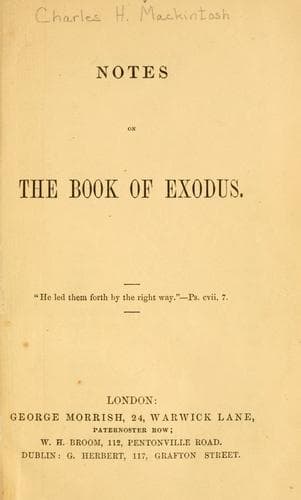
Notes on the book of ExodusMackintosh, Charles Henry
Religion
Notes on the book of Exodus
Mackintosh, Charles Henry
Bible. Exodus -- Commentaries
But then, inasmuch as we are, in God's view, eternally associated with
Him who has passed right through into the heavenlies, and taken His
seat there in triumph and majesty, it is our happy privilege to know
ourselves, by faith, as "sitting together in Him" there. (Eph. ii.) So
that although we are, as to our bodies, in Egypt, we are, as to our
experience, in the wilderness, while, at the same time, faith
conducts us, in spirit, into Canaan, and enables us to feed upon "the
old corn of the land," _i.e._, upon Christ, not as One come down to
earth merely, but as One gone back to heaven and seated there in
glory.
The concluding verses of this fifteenth chapter show us Israel in the
wilderness. Up to this point, it seemed to them to be all fair
sailing. Heavy judgments poured upon Egypt, but Israel perfectly
exempt,--the army of Egypt dead upon the sea shore, but Israel in
triumph. All this was well enough; but, alas! the aspect of things
speedily changed. The notes of praise were soon exchanged for the
accents of discontent. "When they came to Marah, they could not drink
of the waters of Marah, for they were bitter; therefore the name of it
was called Marah. And the people murmured against Moses, saying, 'What
shall we drink?'" Again, "The whole congregation of the children of
Israel murmured against Moses and Aaron in the wilderness; and the
children of Israel said unto them, 'Would to God we had died by the
hand of the Lord in the land of Egypt, when we sat by the flesh-pots,
and when we did eat bread to the full! for ye have brought us forth
into this wilderness to kill this whole assembly with hunger.'"
Here were the trials of the wilderness.--"What shall we eat?" and
"What shall we drink?" The waters of Marah tested the heart of Israel
and developed their murmuring spirit; but the Lord showed them that
there was no bitterness which He could not sweeten with the provision
of His own grace. "And the Lord showed him a tree, which when he had
cast into the waters, the waters were made sweet; there he made for
them a statute and an ordinance, and there he proved them." Beauteous
figure this of Him who was, in infinite grace, cast into the bitter
waters of death, in order that those waters might yield naught but
sweetness to us forever! We can truly say, "The bitterness of death is
past," and nothing remains for us but the eternal sweets of
resurrection.
Public-domain text, read in full here on John Shaqi.
Reviews
Reviews
No reviews yet
Be the first to share your thoughts on this work.
Elsewhere in the archive
Join the Discussion
Join the discussion
Sign in to leave a comment or review.
Sign InorCreate an account