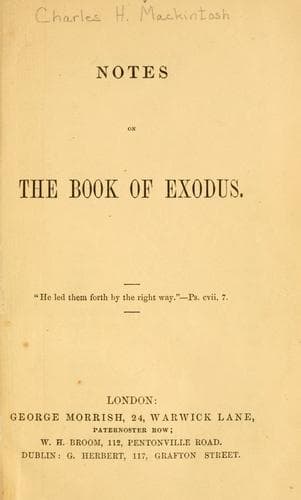
Notes on the book of ExodusMackintosh, Charles Henry
Religion
Notes on the book of Exodus
Mackintosh, Charles Henry
Bible. Exodus -- Commentaries
Some there are who seek to overlook the fact of the Christian's
conflict with the flesh. They look upon regeneration as a total change
or renewal of the old nature. Upon this principle it would necessarily
follow that the believer has nothing to struggle with. If my nature is
renewed, what have I to contend with? Nothing. There is nothing
within, inasmuch as my old nature is made new; and nothing without can
affect me, inasmuch as there is no response from within. The world has
no charms for one whose flesh is entirely changed, and Satan has
nothing by or on which to act. To all who maintain such a theory, it
may be said that they seem to forget the place which Amalek occupies
in the history of the people of God. Had Israel conceived the idea
that when Pharaoh's hosts were gone their conflict was at an end, they
would have been sadly put about when Amalek came upon them. The fact
is, _theirs_ only then began. Thus it is with the believer, for "all
these things happened unto Israel for ensamples, and they are written
for our admonition." (1 Cor. x. 11.) But there could be no "type," no
"ensample," no "admonition," in "these things" for one whose old
nature is made new. Indeed, such an one can have but little need of
any of those gracious provisions which God has made in His kingdom for
those who are the subjects thereof.
We are distinctly taught in the Word that the believer carries about
with him that which answers to Amalek, that is, "the flesh"--"the old
man"--"the carnal mind." (Rom. vi. 6; viii. 7; Gal. v. 17.) Now, if
the Christian, upon perceiving the stirrings of his evil nature,
begins to doubt his being a Christian, he will not only render himself
exceedingly unhappy, but also deprive himself of his vantage-ground
against the enemy. The flesh exists in the believer and will be there
to the end of the chapter. The Holy Ghost fully recognizes it as
existing, as we may easily see, from various parts of the New
Testament. In Romans vi. we read, "Let not sin therefore _reign_ in
your mortal bodies." Such a precept would be entirely uncalled for if
the flesh were not existing in the believer. It would be out of
character to tell us not to let sin reign, if it were not actually
dwelling in us. There is a great difference between dwelling and
reigning. It dwells in a believer, but it reigns in an unbeliever.
However, though it dwells in us, we have, thank God, a principle of
power over it. "Sin shall not have dominion over you; for ye are not
under the law, but under grace." The grace which, by the blood of the
cross, has put away sin, insures us the victory, and gives us present
power over its indwelling principle.
Public-domain text, read in full here on John Shaqi.
Reviews
Reviews
No reviews yet
Be the first to share your thoughts on this work.
Elsewhere in the archive
Join the Discussion
Join the discussion
Sign in to leave a comment or review.
Sign InorCreate an account