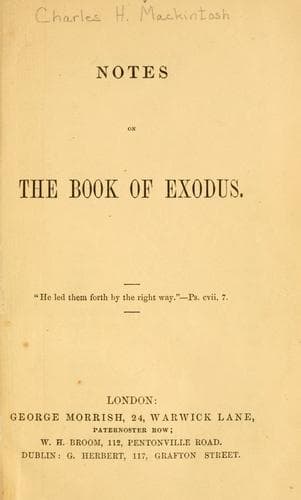
Notes on the book of ExodusMackintosh, Charles Henry
Religion
Notes on the book of Exodus
Mackintosh, Charles Henry
Bible. Exodus -- Commentaries
We have died to sin, and hence it has no claim over us. "He that has
died is justified from sin." "Knowing this, that our old man has been
crucified with Him, that the body of sin might be destroyed, that
henceforth we should not serve sin." (Rom. vi. 6.) "And Joshua
discomfited Amalek and his people with the edge of the sword." All was
victory; and Jehovah's banner floated over the triumphant host,
bearing the sweet and heart-sustaining inscription, "Jehovah-nissi"
(the Lord my banner). The assurance of victory should be as complete
as the sense of forgiveness, seeing both alike are founded upon the
great fact that Jesus died and rose again. It is in the power of this
that the believer enjoys a purged conscience and subdues indwelling
sin. The death of Christ having answered all the claims of God in
reference to our sins, His resurrection becomes the spring of power in
all the details of conflict afterwards. He died _for_ us, and now He
lives _in_ us. The former gives us peace, the latter gives us power.
It is edifying to remark the contrast between Moses on the hill and
Christ on the throne. The hands of our great Intercessor can never
hang down. His intercession never fluctuates. "He _ever_ liveth to
make intercession for us." (Heb. vii.) His intercession is
never-ceasing and all-prevailing. Having taken His place on high, in
the power of divine righteousness, He acts for us according to what He
is, and according to the infinite perfectness of what He has done. His
hands can never hang down, nor can He need any one to hold them up.
His perfect advocacy is founded upon His perfect sacrifice. He
presents us before God, clothed in His own perfections, so that though
we may ever have to keep our faces in the dust, in the sense of what
we are, yet the Spirit can only testify to us of what He is before God
for us, and of what we are in Him. "We are not in the flesh, but in
the Spirit." (Rom. viii.) We are in _the body_, as to the fact of our
condition; but we are not in _the flesh_, as to the principle of our
standing. Moreover, the flesh is in us, though we are dead to it; but
we are not in the flesh, because we are alive with Christ.
We may further remark, on this chapter, that Moses had the rod of God
with him on the hill--the rod with which he had smitten the rock. This
rod was the expression or symbol of the power of God, which is seen
alike in atonement and intercession. When the work of atonement was
accomplished, Christ took His seat in heaven, and sent down the Holy
Ghost to take up His abode in the Church; so that there is an
inseparable connection between the work of Christ and the work of the
Spirit. There is the application of the power of God in each.
CHAPTER XVIII.
Public-domain text, read in full here on John Shaqi.
Reviews
Reviews
No reviews yet
Be the first to share your thoughts on this work.
Elsewhere in the archive
Join the Discussion
Join the discussion
Sign in to leave a comment or review.
Sign InorCreate an account