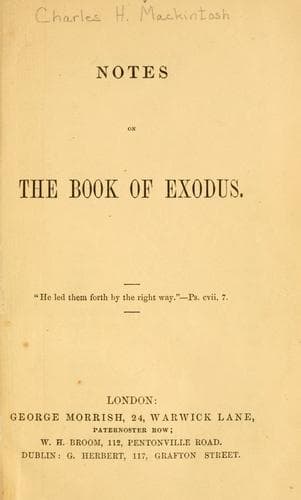
Notes on the book of ExodusMackintosh, Charles Henry
Religion
Notes on the book of Exodus
Mackintosh, Charles Henry
Bible. Exodus -- Commentaries
I cannot close this chapter without noticing, in connection, a passage
in the book of Deuteronomy which may present a difficulty to some
minds. It has direct reference to the subject on which we have been
dwelling. "And the Lord heard the voice of your words, when ye spake
unto me; and the Lord said unto me, 'I have heard the voice of the
words of this people, which they have spoken unto thee: _they have
well said all that they have spoken_.'" (Deut. v. 28.) From this
passage it might seem as though the Lord approved of their making a
vow; but if my reader will take the trouble of reading the entire
context, from verse twenty-four to twenty-seven, he will see at once
that it has nothing whatever to say to the vow, but that it contains
the expression of their terror at the consequences of their vow. They
were not able to endure that which was commanded. "If" said they, "we
hear the voice of the Lord our God any more, then we shall die. For
who is there of all flesh that hath heard the voice of the living God
speaking out of the midst of the fire, as we have, and lived? Go thou
near, and hear all that the Lord our God shall say; and speak thou
unto us all that the Lord our God shall speak unto thee, and we will
hear it and do it." It was the confession of their own inability to
encounter Jehovah in that awful aspect which their proud legality had
led Him to assume. It is impossible that the Lord could ever commend
an abandonment of free and changeless grace for a sandy foundation of
"works of law."
CHAPTER XX.
It is of the utmost importance to understand the true character and
object of the moral law, as set forth in this chapter. There is a
tendency in the mind to confound the principles of law and grace, so
that neither the one nor the other can be rightly understood. Law is
shorn of its stern and unbending majesty, and grace is robbed of all
its divine attractions. God's holy claims remain unanswered, and the
sinner's deep and manifold necessities remain unreached, by the
anomalous system framed by those who attempt to mingle law and grace.
In point of fact, they can never be made to coalesce, for they are as
distinct as any two things can be. Law sets forth what man ought to
be, grace exhibits what God is. How can these ever be wrought up into
one system? How can the sinner ever be saved by a system made up of
half law, half grace? Impossible. It must be either the one or the
other.
Public-domain text, read in full here on John Shaqi.
Reviews
Reviews
No reviews yet
Be the first to share your thoughts on this work.
Elsewhere in the archive
Join the Discussion
Join the discussion
Sign in to leave a comment or review.
Sign InorCreate an account